Tuesday, July 26, 2011

Not the Kingdom You Were Expecting


Some days, there's a man with a sign standing on the southeast corner of the city hall lawn, where the road leading to my house dead-ends at Route 66. Sometimes, his sign alleges that abortion is murder  and sometimes it proclaims that Jesus is the only way to be saved from eternal damnation, but last week it was telling me to repent, because the Kingdom of God is near.

"The Kingdom of God is near," we are told. The words sound strange. From the perspective of a political science student living in a representative democracy in the early-21st century, a kingdom doesn't necessarily sound like a good thing. The word kingdom conjures up all kinds of images of brutal tyrants and plagues and little thatched huts. It doesn't sound like the kind of place where I'd want to live. Maybe "kingdom" doesn't mean what we think it does.

In Matthew 13:31-33, 44-52, we are confronted with a laundry list of parables explaining what this kingdom is all about. It's unlikely that Jesus really said all of these in one sitting, so we can think of this as a "Greatest Hits" list that the gospel writer put together. The parables may not have been meant to go together, but the picture they paint is of a kingdom that is very strange indeed — not at all like the kingdom we heard about in Sunday School.

In the first of these parables, Jesus says, "The kingdom of heaven is like a mustard seed that someone took and sowed in his field; it is the smallest of seeds, but when it has grown, it is the greatest of shrubs and becomes a tree, so that the birds of the air come and make nests in its branches."

A mustard seed? Really? Jesus' audience must have thought they heard him wrong. When you think of a plant that you would use to represent a mighty kingdom, you think of something large and majestic like an oak or a cedar, not the mustard plant. In Jesus' day, mustard was a weed, and a scrawny one at that. If left to its own devices, it would consume your field. So, the Kingdom of Heaven is a weed. Hmm.

In the second parable, the Kingdom of Heaven is compared to "yeast that a woman took and mixed in with three measures of flour until all of it was leavened." So, now the Kingdom of Heaven is a microorganism that looks dormant most of the time, but under the right conditions will disappear entirely, leaving only its effects visible. Curiouser and curiouser.

These are all strange ways of describing a kingdom, but Jesus isn't done yet. Skipping ahead a little in the text brings us to Matthew 13:44-52. Here, he fires off three parables in rapid succession. It's enough to leave you reeling. The Kingdom of Heaven is a treasure hidden in a field that someone finds, reburies, and sells everything they have to purchase the field. The Kingdom of Heaven is also like a merchant who sells everything he has to own just one pearl. The Kingdom of Heaven is also a net that catches fish of every kind, bringing them to shore to be sorted.

Never once does Jesus describe the kingdom of his father in the terms of an earthly kingdom. There is no ruler and no subjects in a traditional sense. No palaces, no walls, no armies standing guard. To think of the kingdom in those terms is to limit God, who far surpasses our puny abilities to understand the nature of the universe.

What then, is the Kingdom we hear so much about in church and on street corners? What is this paradoxical realm that Jesus is describing?

The Kingdom is a living thing — an organism that is invisible  but recognizable through what it creates. The Kingdom is hidden; buried, and must be uncovered; unleashed. The Kingdom draws everyone in, making no distinction between the differences we perceive. The Kingdom makes you desperate, drives you to leave everything you have so you can be a part of it. The Kingdom is insidious; a weed that takes over and spreads to consume everything. The Kingdom sounds impossible, but it is here and it is now. It is all around us and it is in us. The Kingdom is beyond our comprehension.

This is the Kingdom as it is, but not the kingdom we were expecting. It is dynamic and powerful. It is inescapable. The Kingdom of God isn't near: It's here. It's been here all along.

Thursday, July 7, 2011

Minneapolis: The Right Wrong Man for the Job


In high school, I was not part of my church's youth group. I didn't exactly believe in God in those days. I was never confirmed and I certainly didn't attend any big Lutheran youth events. I was skeptical of the born-again mentality and the "rah-rah Jesus" crowd and I still am. So, imagine my surprise when I received a phone call from a beloved former pastor asking me to be part of the creative team for the 2012 ELCA Youth Gathering in New Orleans. Now, imagine my surprise when I considered the offer and said, "yes."

Next summer, some 37,000 high school-aged Lutherans will descend on the city of New Orleans for a week of spiritual excitement. And I, of all people, am helping to shape their experience. It blows my mind that I am currently sitting in a hotel room just south of Minneapolis, considering how to welcome and engage that many young people. The people in charge must not have heard about me.

I shouldn't make assumptions about the people who attend these gatherings and what they experience. From what I heard, the experience is powerful, even transformative. That's a lot of pressure being on the planning side of things.

Yet, I find my biases disappearing. The other members of the team come from all walks of Lutheranism across the country and are committed to making this an event that fires people up without being corny; excites people without being elitist. I hope that my unique perspective — as an outsider, as a doubter, as a Christian who hasn't quite figured out the Jesus thing — will help make this event profound and grounded in the realities of faith instead of what one member of our team called "cotton candy faith" (ie. mostly air).

The theme of the Gathering is "Citizens with the Saints," taken from Paul's letter to the early church in Ephesus. In Ephesians 2:14-20, Paul (or a later writer heavily influenced by the Pauline tradition) writes:

"For he is our peace; in his flesh he has made both groups into one and has broken down the dividing wall, that is, the hostility between us. He has abolished the law with its commandments and ordinances, so that he might create in himself one new humanity in place of the two, thus making peace, and might reconcile both groups to God in one body through the cross, thus putting to death that hostility through it. So he came and proclaimed peace to you who were far off and peace to those who were near; for through him both of us have access in one Spirit to the Father. So then you are no longer strangers and aliens, but you are citizens with the saints and also members of the household of God, built upon the foundation of the apostles and prophets, with Christ Jesus himself as the cornerstone."

 In this piece of Scripture, I see so much potential. Here, we as a community admit that we are broken and split, but reconciled through Jesus' death. We have been outcasts and outsiders, but God has taken us in and given us citizenship. We have become members of the family.

In the next few days, the creative team will wrestle with how to bring this Scripture to life for tens of thousands of teenagers. The challenge excites me and I am eager to contribute in my own small way to the discussion. The future of the church rests with the youth and it is my honor to help guide that future through what these students see, hear, and feel at this gathering.

To look at my past, I would appear to be the wrong person for this job, but Christ has broken down the dividing wall and made me a citizen of a new nation. With God guiding me this weekend, I think I might just be the right wrong person for the job.

Saturday, July 2, 2011

How Do We Punish Evil?

Medieval depiction of Charon ferrying souls to Hell, from Dante's Divine Comedy.


I watched the clock on Thursday morning, waiting for 11:11 am, when I knew a man was going to die. Richard Bible, 49, of Flagstaff, was executed by the State of Arizona by lethal injection and I was unsure about how I felt about it.

I spent the morning reading articles, trying to form an opinion. Bible had been on Death Row for more than 20 years, after being convicted of the molestation and murder of a 9-year-old girl in 1988. People were saying that justice was finally being served.

People like Bible make me sick. I can't imagine what could possess someone to commit such horrific crimes. I don't know if it there really is such a thing as evil, but if it exists, it must take the form of rapists and murderers. A little girl had been tortured and brutally killed. I can understand why people were calling for blood, for revenge, for justice.

And yet, at 11:11 am, I took a moment to say a short prayer. I wasn't asking for God to forgive this man or excuse his crimes. I prayed for his family and for the family of his victim, who had suffered for 23 years. And I asked God if this was right. Should we govern the world we are here to take care of on a system of "an eye for an eye?"

In Exodus 21:12, the law given to Moses explicitly states "Whoever strikes a person mortally shall be put to death." In Exodus 21:23-24, it is decreed that "If any harm follows, you shall give life for life, eye for eye, tooth for tooth, hand for hand, foot for foot." The law is clear and the punishment is severe, as it is today.

Yet, Jesus appears to contradict this, saying in his Sermon on the Mount, "You have heard that it was said, 'And eye for an eye and a tooth for a tooth.' But I say to you, Do not resist an evildoer. But if anyone strikes you on the right cheek, turn the other also" (Matthew 5:38-39). Does Jesus really want us to be passive and do nothing when we're harmed? Wouldn't that just lead to a world where those who follow Jesus' teachings are oppressed and those who practice evil are free to do as they please?

Like so much of what Jesus says, this just feels wrong. Our judicial system operates on the basis of punishment. If you kill someone, the system kills you. A life for a life. People like Bible shouldn't be allowed to go free. It makes sense to punish them, but it won't return Jennifer Wilson. It won't replace her and it won't free her family of the anguish I'm sure they still feel over her loss.

I feel a sense of relief when men like Bible are punished. It feels like balance has been restored and yet, I can't revel in the death of a human being. I feel spiritually dirty when I catch myself thirsting for vengeance — like I'm cheering at the Coliseum, hoping to see a man's blood spilled.

I'm beyond confused. On the one hand, I think Bible got exactly what he deserved. On the other, I know that Jesus' way is one of love and grace for people who don't deserve it. Was the state justified in sentencing Bible to death? Am I right to feel good about it? Is this a fair exchange for the life of a 9-year-old that was cut short?

What am I supposed to believe, as a Christian-in-progress? How am I supposed to feel?

Monday, May 23, 2011

Angry at God


Do you ever feel like the whole world is against you? Like your entire life is crashing down around you? Do you ever get so frustrated with your situation that you just want to lash out and scream curses at the heavens?

If you've hung around me for any length of time, you've probably heard me bring up Psalm 77 (one of my favorite verses). In it, the Psalmist wonders if God has abandoned him, saying:

"You keep my eyelids from closing;
   I am so troubled that I cannot speak.
I consider the days of old,
   and remember the years of long ago.
I commune with my heart in the night;
   I meditate and search my spirit:

‘Will the Lord spurn for ever,
   and never again be favourable?
Has his steadfast love ceased for ever?
   Are his promises at an end for all time?
Has God forgotten to be gracious?
   Has he in anger shut up his compassion?’"
- Psalm 77:4-9

When the world is dark and we cannot see the light, has God deserted us? Does he even care? We hear so much about a God who loves and provides, but there are times when I can't see it. How is God providing for us when we lose our jobs or our loved ones? How is God demonstrating love when we're pushed aside and told we're just not good enough? Were is God when bad things happen to good people?

Like the Psalmist, I question. I want desperately to believe that this is all part of some grand plan, but here in the depths of my life, I feel alone. I'm ashamed to say it, but it is usually when times are the hardest that I have the most trouble believing.

I get angry. I scream at God. I denounce God. I argue with God and try to get him to bend to my will. "If you really love me, you'll fix this mess!" I say. Even when I do things right, I don't always get what I feel I deserve in return. Like Jeremiah, I feel like I've been tricked. "You deceived me, Lord, and I was deceived; you overpowered me and prevailed. I am ridiculed all day long; everyone mocks me" (Jeremiah 20:7).

I get so angry with God and later, after I've gone for a long drive and calmed down a bit, I feel bad about it. But I don't have to apologize. I'm human and God understands that — after all, he made me this way. Yes, I have doubts. Yes, I sometimes get mad at God, but God can take it. And not only does God put up with my outbursts, he forgives me and never waivers in his love for me. I am blind, but God is determined to make me see.


God isn't a vending machine. We don't always get what we want and things don't always work out. And it's okay to be angry. I'm still bitter about the other times when I have felt abandoned by God. It doesn't feel fair and our lives often aren't. Bad things happen to us. We come up short. We lose. But, through it all, God is with us, even when we're sure he's not. It's okay to be angry with God, because no matter what we say or do, he doesn't give up on us. That's gotta be love.

"Your way was through the sea, your path, through the mighty waters; yet your footprints were unseen." - Psalm 77:19

Thursday, May 19, 2011

The End is Nigh (But Don't Quit Your Job Yet)


I'm not making any plans to be Raptured on Saturday morning. Even if the Rapture was coming, I'm pretty sure I wouldn't be going, anyway. But either way, I'm not expecting anything to be different when I wake up on May 21st.

There is a growing group of Christians who believe that the long-awaited end times are upon us. I simply don't buy it.

Human beings have a somewhat dark obsession with the end of the world. It fascinates us and for more than 2,000 years, people have been trying to predict when the Second Coming will occur — and every time, they have been wrong.

Over the centuries, various interpretations of Scripture have pointed to the Rapture and following tribulations as taking place in the year ~30 CE, ~60 CE, 365, 500, 900, 968, 992, 1000, 1033, 1147, 1284, 1496, 1533, 1669, 1689, 1736, 1832, 1843, 1844, 1881, 1914, 1915, 1918, 1920, 1925, 1941, 1975, 1994, and 2000. Every date has come and gone and we're all still here. The odds of being able to pinpoint the exact date are slim-to-nil, if you even believe that such an event is coming in the first place.

I'm not sure I understand this fixation with the End, but I, for one, believe that Revelation is not the most important book in the Bible. I don't believe God wants us worrying about Judgment Day, but about our everyday choices and interactions.


As a Christian-in-progress, I have to ask myself: Would I live my life any differently if I knew that all of history was about to come to a close this week? Perhaps an even better question is: Would I live any differently if I knew that Judgment Day was five billion years away?

We shouldn't have to be scared into behaving ourselves. Second Coming or not, we should endeavor to live every day as Jesus would have lived it were he among us today. We can't control the future and we shouldn't live in fear of what it might bring. All we have is right now and we should do everything in our power to live Christlike lives in the here and now.

1 Thessalonians cautions us, saying, "you know very well that the day of the Lord will come like a thief in the night." So, why should we get worked up about these predictions? God doesn't abide by our timelines. We would do well to be humble and remember that we are called to serve and love one another, not to sit around and waste our lives waiting for a day that probably isn't coming any time soon.

To me, that thought fills me with hope, because I still have a lot of work to do before I'm ready for that day.

Wednesday, May 4, 2011

Flooding Back


[The following is a stream of consciousness post on a deeply personal matter. I'll be back to my normal posts soon.]

I hadn't thought about my childhood in a long time before my sister posted a link on her Facebook page to the '90s ballad, "Truly Madly Deeply." It's a love song that has probably been played ad nauseum at many a high school prom, but to me, this song has a deeper meaning. "Truly Madly Deeply" came out around the same time that my parents separated. We always had the radio on at home and so, for me, this song became the soundtrack to the first rough time in my life.

At seven years old, my whole world changed. I packed up half of my belongings and moved with my mom and 2-year-old sister from our big, beautiful house in an upscale neighborhood to a small, roach-infested apartment in one of the poorer sections of North Las Vegas.

It was scary. I was old enough to understand what was going on, but not quite old enough to understand why. It was the why that terrified me for the longest time. Having your parents divorce when you're young has a way of forcing you to grow up a little faster, even when your mom takes superhuman steps to protect and shield you from it.

I had nearly forgotten the song, but when I clicked on the video and the first notes came trickling through my headphones, I started to cry. All the times we scraped by to the pay the rent, when my mom had to sell rollerblades in dirt lots out of the back of a moving van, and when we would go dumpster diving for furniture and appliances or to Dollar Day at Savers to buy all of our clothes — it all came flooding back to me on a wave of tears that had been repressed for a long time.


Maybe it's just a coincidence that my sister posted this so near to Mother's Day. Listening to this song reminds me of my mom's strength and all of the sacrifices she made for myself and my sister. She was so committed to doing what was best for us. She worked at conventions, handing out flyers, even though she had a college degree in Business Management, so that she could keep my sister out of daycare. If she suffered, she did so quietly and with such dignity that we would've never known.

I don't know for the life of me how she did it. How did we survive on a paltry $300 a month in child support from my father — who never gave any indication that he was concerned for our financial situation? How did my mother hold everything together in the face of such seemingly insurmountable odds? I'll probably never know the depths of her strength and wisdom.

Because of my mom's sacrifices over many years, I have had the opportunity to become the man I am today. I have been able to realize my potential by following her example of hard work and stubborn determination. Her love inspires me. Because of her, so many of those tough times are augmented with beautiful, happy memories.

I'm still a little hurt. I'm still a little angry at my father for putting my family through such hell and haven't spoken to him in almost 5 years. But when I look back, there isn't much I would change. My mother has been happily married to a wonderful, caring man for almost a decade now. I have two more little sisters, whom I love and couldn't imagine living without. I have learned lessons that a life of privilege and money could never have taught me. The person I am today has been shaped and molded by this experience and it is ultimately good.

I feel like I'm getting to place where I will soon be able to heal the scars and I will once and for all put the pain behind me and remember only the good times. I take comfort in loving family, in supportive friends, in a God who doesn't abandon us, and in the words of a love song which was an unlikely source of inspiration in times of darkness:

I will be strong,
I will be faithful,
'Cause I'm counting on 
a new beginning;
a reason for living;
a deeper meaning, yeah.
...
And when the stars are shining brightly in the velvet sky,
I'll make a wish,
send it to Heaven,
then make you want to cry. 
The tears of joy for all the pleasure and the certainty
that we're surrounded by the comfort and protection
of the highest powers,
in lonely hours;
the tears devour you...

Sunday, April 24, 2011

Easter Sunday: Our Resurrection

Your friend's body is missing. His burial clothes are neatly folded in the empty tomb, but there is no corpse. You run to tell your friends, who are in hiding, petrified with fear that they will be the next ones to hang from a cross. Everyone runs back to the tomb, where two luminous beings in white are sitting where the body had been laid. "Why are you weeping?" they ask.

According to the Gospel of John, the disciples did not yet understand the Scriptures saying that Jesus must rise from the dead on Sunday morning. They thought someone had stolen the body and I imagine they were crushed. One last defeat in a terrible week that had turned everything on its head.

Imagine then, your surprise when one of the men in white softly calls your name. It's Jesus. Alive and well after you saw him suffer and die. He's alive!

Everything changes this day. Easter is not merely a celebration of a miracle from 2,000 years ago. The Resurrection has implications across the universe in all times and all places. For through Jesus' death and return from the grave, we are forgiven from all of the sins which had previously condemned us. All of our debts are settled forever. Jesus died for you, so that everyday, we might be resurrected.

We die and if it wasn't for this sacrifice of love, we would never come back. By all reasonable arguments, we don't deserve it. But God isn't bound by rules. God breaks the rules. Death is no longer a one-way street. We can return, even when we are dead to the world. Through Jesus' crucifixion, he has bought us new life.

The fate of everyone changes today, because of a sacrifice that we can't even begin to wrap our heads around. He died so that we could live. And that changes everything.

Saturday, April 23, 2011

Holy Saturday: What Now?

Imagine that you are a disciple the day after Jesus has died and been buried. It is the Sabbath, so you are resting and all you can do is think about the last two days. Your leader has been tried before the high priests and the governor of the Roman occupying force and been sentenced to death. The Son of God is lying in a tomb. It doesn't seem fair. Through the grief and the tears, can you believe that he died as a sacrifice for the sin of the whole world? Can you even begin to believe in a Resurrection?

None of the four Gospels tell us what the disciples did on Saturday, only that "they rested on the Sabbath in obedience to the commandment" (Luke 23:56) . We don't know what they talked about, or if the group was plunged into silence as they contemplated going on without their beloved Teacher.

I imagine I would've been terrified, sad, and angry at the same time. I probably would've been inconsolable. What a traumatic experience it must have been to see your friend die an agonizing death on a cross. The curtain of the temple had torn and an earthquake had rocked Jerusalem. What did it mean? There was no one to interpret the signs and Scriptures for them anymore. It must have felt hopeless.

We don't talk about Holy Saturday very much. We spend a lot of time on the build up to Jesus' arrest and on his death on Friday. Then, we skip straight to Sunday morning, when the three women came to bring spices to the tomb, only to find the stone rolled away and the tomb empty.


But today, Jesus has not risen from the dead. The tomb is sealed and Jesus' body is inside. I often find myself in this Holy Saturday mindset. It doesn't always feel like Jesus came back from the dead, even though I know he did. Sometimes, it feels like he's dead and I'm left to carry on alone. And yet, even when it seems like the story is over, we know that there's more. Death is not the end, but more of a beginning.

Tomorrow, we'll go to the tomb only to discover that someone has rolled away the stone right under the very noses of the Roman guards and the body of the Lord is gone. Logically, the tomb should be sealed, but it won't be, because the grave is no obstacle for God.

Today, it is dark and we must dwell on the sacrifice Jesus willingly made on our behalf. He took our punishment and today, he is dead. We should never forget how important that is. Before he rises, he makes the ultimate sacrifice out of selfless love for us — the people who least deserve it. That, in itself, is incredible.

Today, the tomb is sealed. Tomorrow, everything changes.

Friday, April 22, 2011

Good Friday: A Scared Disciple Flees


"I left everything to follow him. I left my mother and father. I abandoned my way of life and the town where I've spent my entire life. He told to me to follow him and I just did. It was like God himself was parting the heavens and nudging me in Jesus' direction. It just felt right.


"Things were great for a long time. I traveled all over witnessing miracles — Jesus restoring sight to the blind, healing the sick, and feeding five thousand people with just a few fish and a couple loaves of bread. I have seen things I can't even begin to describe.


"But it wasn't all spectacle. There were quiet nights in sleepy towns where we would gather around a small fire and Jesus would talk for hours. Sometimes he would argue with Peter or Judas. Sometimes he would tell us beautiful things about the kingdom that was to come. Sometimes, he would just joke around.


"I really thought he was going to be the Messiah. I thought that final push into Jerusalem would signal the start of the rebellion; the glorious beginning of a new kingdom here on Earth, with Jesus on the throne as our king and the Romans cowering in fear.


"When we came into town on Sunday, it sure felt like we were about to do something great. People flocked to see Jesus come into town. They threw their cloaks and palm branches down before him and praised his name. Then, he threw the hypocrites out of the temple. It seemed like a new era was at hand.


"But I guess we were wrong. I guess it just wasn't in the cards. It's still so fresh that I'm not even sure where we went wrong. Things were going great and then all this talk of death and carrying on the message. Like Jesus was just giving up.


"They arrested him. They beat him senseless, until he could barely stand. I'm sure they must have broken something, they hit him so hard. They stripped off his clothes and divided them among the guards. People screamed and spat. There was nothing any of us could do, except watch in shock as the last three years came crashing down.


"They tortured him on that cross. I could see from where I was standing that he was suffering more than any man had ever suffered before. My God, my God, why have you forsaken us?


"He died. He should have been the new King of Israel, the Messiah, and there he hung, lifeless, from a cross. They killed my friend; my teacher; my God. And I ran. I ran without looking back. I ran until my lungs burned and my knees gave out and I fell into the dusty road. I wept and screamed. He's dead. And we're probably all next. The talk of love, of eternal life, and of fulfilling the Scriptures was all just a beautiful dream and this is reality.


"Eli, Eli, lema sabachthani? My God, my God, why have you forsaken me?"

Maundy Thursday: Foot Washing

I have never had my feet washed. Not outside of a shower, that is. And while I had a dim memory about a story involving Jesus and foot washing, I had never given it serious thought before last night.

Last night was Maundy Thursday, the traditional observance of the night before Christ was crucified. In one of his final acts before his arrest, Jesus poured water into a basin and washed his disciples' feet, drying them with the towel wrapped around his waist.

Simon Peter initially resists. "No, you shall never wash my feet," he says in John 13:8. Washing feet was the work of servants. The feet were — and in my case, are — the smelliest, dirtiest part of the body. To wash someone's feet was to acknowledge that they were inferior. But Jesus, as he always does, turns conventional wisdom on its head.

"Now that I, your Lord and Teacher, have washed your feet, you also should wash one another’s feet," Jesus says to his astonished disciples. "I have set you an example that you should do as I have done for you. Very truly I tell you, no servant is greater than his master, nor is a messenger greater than the one who sent him. Now that you know these things, you will be blessed if you do them."

No servant is greater than his master, nor is a messenger greater than the one who sent him. It must have been powerful, being in that room and hearing these words from the man you had given up your livelihood to follow. Once again, Jesus redefines what it is to be a child of God. Like the disciples, we are called to wash one another's feet — to be humble.


A hush fell over the sanctuary as warm water was poured from a pitcher into a large bowl last night. After a moment of hesitation, we all started to remove our shoes. I slipped off my sneakers and socks and rolled my blue jeans up above my calves. Ambient music filled the space like some ethereal orchestra. One by one, people went up to have their feet washed and then to wash the next person's feet.


I remember that I winced for a moment when the water first hit my feet. It was uncomfortable at first, having someone touching my feet and lightly rubbing away the dirt my soul had tracked in. But then, the meaning hit me. I had to submit and be cleansed. I had to be truly clean before my fellow travelers and before my God. 

When I stepped up, smiled at Kristi (who had kindly washed my feet) and took the towel from her, I felt clean. Not without blemish, but certainly more spiritually presentable than I've been in a long time. I knelt and waited for the next person to come, so that I could wash their feet.


As someone who is often prideful to the point of arrogance, kneeling there before the bowl of water — washing Jess' feet in near silence — I saw a glimpse of the man I am called to be. I felt humbled and privileged to be able to offer such a simple, yet profound gesture of humility. The Spirit was in that space with us, surrounding us and penetrating us, inhabiting the living water we were washing in.


In the coming days, as I wait for the good news of the Resurrection, I'm going to reflect on this experience and what it means for me and my path. In his liturgy for Maundy Thursday, Shane Claiborne offers this closing prayer:


Lord Jesus Christ, you knelt to wash from our feet the dirt out of which you made us. Teach us to humbly serve one another so that the world may know we are your disciples. Amen.

Saturday, March 19, 2011

San Francisco: The Least of These

"Come, you who are blessed by my Father; take your inheritance, the kingdom prepared for you since the creation of the world. For I was hungry and you gave me something to eat, I was thirsty and you gave me something to drink, I was a stranger and you invited me in,  I needed clothes and you clothed me, I was sick and you looked after me, I was in prison and you came to visit me." 
- Matthew 25:34-36


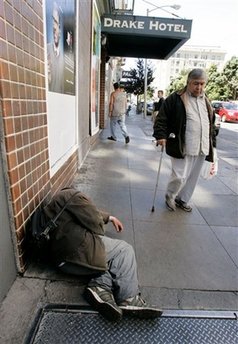
This past week, I was privileged to spend time in San Francisco with Lutheran Campus Ministry at Northern Arizona University. We went to see how the church was adapting to and embracing the LGBTQ community as well as to witness to the desperation of the homeless community. To say the experience was powerful is an understatement.

I went in expecting to be a spectator, tapping on the glass of an urban zoo, but much to my surprise, I was fully immersed in the city and its complexity. I heard the stories of the homeless of San Francisco. I saw them as human beings and in them, I saw the presence of God.

My week in San Francisco will require months — if not years — to process and decipher. The interactions I had with members of the larger community and the bonds I formed with the smaller LCM community over late night discussions and shared experiences has shaken my faith and strengthened my desire to learn more.

The city itself is a contradiction. Poverty and decadence go hand-in-hand with one another. I remember one night, I sat and spoke with a homeless man (who in all honesty was a human Bible, constantly quoting scripture). His hands and face were filthy and right across the street was a Macy's and a Tiffany's. Everything he could not have was right there — where the homeless and the wealthy share the same streets. Despite all this, he said with a grin, "I'm not homeless. I'm just not home yet." I was struck by the stark socioeconomic stratification that we in America see everyday. Why are we not outraged? Perhaps more importantly: Why aren't we motivated to do something about it?

Whatever you did for one of the least of these brothers and sisters of mine, you did for me.

We have heard this story from Matthew many times and we tend to focus on the first section, where Jesus praises those who help the needy. Yet, I find that I usually fall into the second group — the people who ignore the "untouchables" of our society. We brush past the beggar with his plastic cup and we avoid eye contact with the lonely woman at the bus stop who just needs someone to talk to her. In our minds, we find ways to justify it. "Why doesn't she get a job?" "He just wants money to get drunk or high." Maybe that is the case, but it doesn't mean we shouldn't treat them with dignity. Maybe all they really need is a smile or a kind word. Maybe they just need someone to validate their humanity.

To all of us who would rather pretend like they're not really there, Jesus has his message:  

"'Depart from me, you who are cursed, into the eternal fire prepared for the devil and his angels. For I was hungry and you gave me nothing to eat, I was thirsty and you gave me nothing to drink, I was a stranger and you did not invite me in, I needed clothes and you did not clothe me, I was sick and in prison and you did not look after me.'
   
"They also will answer, 'Lord, when did we see you hungry or thirsty or a stranger or needing clothes or sick or in prison, and did not help you?'
   
"He will reply, 'Truly I tell you, whatever you did not do for one of the least of these, you did not do for me.'"
- Matthew 25:41-45

 My experience was uncomfortable at times, but it's when we are at our most uncomfortable that we often encounter the divine. Jesus is here among us, but he is not sitting in the pews of our churches and he is not attending dinner parties in the rich neighborhoods of San Francisco. He is sleeping in a doorway tonight without a blanket, without the medicine he needs and without so much as a friendly smile from a stranger. 

What do we do with that? I don't know, but together, maybe we can figure it out.

Monday, February 14, 2011

My Confession

Let me be the first to say that I was wrong.

Let me admit that my ways have not glorified God's name. I have harbored resentment in my heart. I have spoken ill of my friends and my enemies. I have followed the crowd when I should have stood firm. I have sinned. I have sinned so many times and so often that I hardly notice anymore; it is so ingrained in me that it has become habit.

I am broken. I am broken beyond words. I am a festering sore in the world, not a shining beacon of love. That is my problem. I have not loved. I have denounced my friends in the heat of the moment. I have not loved the way I am called to love. I am so wrong about so many things that I cannot begin to explain it.

I am arrogant, prideful, and convinced that only my way is correct. I need new eyes to see how very wrong I am. I need to make a 180 degree turn, because I am on a collision course with ruin.

To err is human. I accept that. I am humbled by that and by the fact that God always grants me a free gift of grace and a fresh start, no matter how many times I abuse it. I need to be humbled more often. I have lived a life of sin. I have polluted myself with my fickle emotions and quick, slashing rebukes.

I must live as your son lived and died, Oh God. I must be humble enough to carry the cross. I am not good at this, but I pray for the strength to try.

Let me be the first to say I'm sorry I let things go this far. Let me say that I'm sorry I didn't see the irony — that I did not see the answer to my questions in the very Bible I was trying to interpret. I cannot be as loving as Jesus, but I must strive to be more Christlike in all my interactions.

Create in me a new heart, Oh God. One that isn't swayed by ego or dubious morality. Let me be more like Jesus in all I say and do. Let me love your sons and daughters a ten thousandth as much as you do. I don't know why it took so long for me to get over myself and realize who you're calling me to be. I am broken and it is only through the mercy of God and following in the footsteps of Jesus that I can be made whole.

"I confess to almighty God,
and to you, my brothers and sisters,
that I have sinned through my own fault,
in my thoughts and in my words,
in what I have done,
and in what I have failed to do;
and I ask you, my brothers and sisters,
to pray for me to the Lord, our God."

- Common Prayer: A Liturgy for Ordinary Radicals

Let me be the first to say that I was wrong. I need the help of my Father in Heaven and of my brothers and sisters on Earth to get through this dark time. Please, pray for me.

Saturday, January 22, 2011

The 21st Century Church, Part Three: Leadership

I am always comforted when I read about the disciples. They consistently misunderstand Jesus, who he is, and why he came, just as I often do.

Over and over again the disciples persist in their belief that Jesus came to be a conquering king who would throw out the Roman oppressors by force. For them, Jesus was not just a leader, but a ruler who would do everything for them and deliver Israel from her occupation.

In many ways, we have a similarly lopsided view of leadership. We look for decisive leaders who will lead the charge and tell us exactly what to do. This is especially apparent in our church experience today. In most churches, we look to the pastor, priest, or minister to lead us, almost to the point of having them serve as faith surrogates — having them believe for us, telling us what to think, and taking care of the difficult questions so we don't have to.

That's not to say we don't need leadership. We do, but we don't need clergy to do all of the heavy work for us. We need people who can guide discussions and we need mentors, but we don't need the kind of leader who becomes the focus of church instead of the message. Jesus did not come to be that kind of leader. Jesus came to exemplify servant leadership — a person who leads by walking the walk.

Peter Rollins believes that the church of the future requires a different type of leader: One who refuses to lead. What we need are facilitators, people with expertise in theology and worship who can nudge us in the right direction; conversation moderators instead of de facto heads of the church.

It isn't the fault of our current leadership that church has become a spectator sport. We don't want to take responsibility. We don't want to assume the risk that comes with servant leadership.

But if we are going to be serious about following the path of Jesus we need to get down in the trenches. Only by getting our hands dirty in the work of faith can we ever claim ownership of our identity as followers of Jesus — as Christians we need leaders who push us to think, to question, and to discover on our own. We cannot live vicariously through our leaders.

If we don't take on that mantle of leadership, we as a whole can never hope to truly know what it means to be a disciple. We have been given a task to be the light of the world and bring justice to the nations and it is only by carrying out that mission that we make our faith real and keep Christianity relevant to the world.

Monday, January 3, 2011

The 21st Century Church, Part Two: Passion & Compassion

I heard somewhere that people have been using the word "church" incorrectly for centuries. "Church" has come to used as a noun — a word for the building, and occasionally applied to the people who gather inside its protective walls. However, "church" takes on a different meaning when you use it as a verb instead. The verb "chuch" becomes a action or a behavior — an experience instead of the physical bricks and mortar.

That's the kind of church that I long for. Nowhere in the Bible can I find the place where Jesus commanded his disciples to go build a bunch of cathedrals. So often, we "go to church," meaning that we go to a building that houses our entire religious experience. What a mundane way to experience faith. If we limit it to just the confines of four walls for one hour, one day a week, then we have completely missed the point.

This is yet another reason why I think the (noun) Church is struggling. There's very little satisfaction in such a shallow experience. In Acts 2:42-47, we get a very different sense of the experience of being church: "They devoted themselves to the apostles’ teaching and fellowship, to the breaking of bread and the prayers. Awe came upon everyone, because many wonders and signs were being done by the apostles. All who believed were together and had all things in common; they would sell their possessions and goods and distribute the proceeds to all, as any had need. Day by day, as they spent much time together in the temple, they broke bread at home and ate their food with glad and generous hearts, praising God and having the goodwill of all the people. And day by day the Lord added to their number those who were being saved."

That is what our experience could be — a dynamic church of devotion to teaching, fellowship, and community. An experience that combines passion for scripture and contemplation with a deep passion for outreach and goodwill. We, too, could praise God with glad and generous hearts, but to do so, we need to open the doors of our exclusive cliques. We have to leave the building and show compassion for our neighbors with the passion and zeal of the disciples gathered at Pentecost.

Some denominations are better at this than others (though now is not the time or place to be drawing those distinctions) and that is why I believe it is vitally necessary that a new, emerging branch of Christianity embrace the qualities of many diverse groups.

A 21st century Christianity should combine passion for God with compassion for those in need. Only then will it be relevant in our postmodern world.

Sunday, January 2, 2011

The 21st Century Church, Part One: Egalitarianism

It has been over 2,000 years since Jesus — the Word made flesh — came to live and die among us. 2,000 years since the teachings of a radical young Jewish rabbi inspired the founding of a major world religion. There have been many changes in Christendom since those early days and sometimes it can be hard to tell what parts of our church experience have been there from the beginning and which have accumulated over time.

The question I have is: Do we need all this extra stuff? How important is the ceremony and frills to our relationship with God? I know I'm not the only one asking these questions. I think most people are asking them deep down. What we need is not just an answer, but a new direction. The church is going to change in the 21st century. And I'm going to humbly attempt to articulate how in my next few blog posts.

The first big shift I see is away from the hierarchical church system we see today. I was privileged to have a foretaste of that church last night, when I sat down with my good friend Ron and dissected this week's scripture readings. What emerged from the evening was a deeper understanding of the text than could ever be gained from a sermon (no offense to any members of the clergy who might read this).

I suspect that this is much like the early Christian church in the first decades after Jesus' death and resurrection — a group of equals sitting down at a table, breaking bread together and discussing the tricky questions of theology and practice.

This our heritage, and I suspect it is also our future. There was no distinction between those behind the altar and those in the pews. There was discussion in an egalitarian community. Church, therefore, is not an individual experience, but a communal one.

A non-hierarchical church centered around the Word and the Eucharist, where we are all equal members of the priesthood and engaged in deep, ongoing conversation and discovery. That's the church I want to be a part of.

Monday, December 6, 2010

Grace to a Sinner


On that dark day at Calvary, Jesus was crucified alongside two criminals. In Luke 23:39-43, one of the criminals is indignant. He yells at Jesus, saying, "Are you not the Messiah? Save yourself and us!"

The second criminal rebukes him, saying, "Do you not fear God, since you are under the same sentence of condemnation? And we indeed have been condemned justly, for we are getting what we deserve for our deeds, but this man has done nothing wrong."

There are times when I wonder who I am in this account. Am I the bitter criminal hurling insults at God? Or am I the man who knows that I am rightfully condemned and have no one to blame but myself?

I will admit there are times when I am bitter. I get angry at God. I feel abandoned when things don't go right; when it feels the entire universe is conspiring against me. And so I scream to the heavens and demand an answer and compensation. I feel that God owes me something and is denying me the good that I deserve. After all, how many tests am I supposed to silently suffer through before I can ask when it will all pay off?

It's about this time that I remember how much I am like the second man on the cross that day. When I look at my life, I am often ashamed of what I see. I have the capacity to be a very un-Christian person. I am judgmental, lazy, cruel, selfish, hateful, lustful, and gluttonous. I don't consider others before myself. I put earthly gains over spiritual pursuits. I'm not just a sinner, I'm a repeat offender — taking forgiveness and then slipping back into my old ways. There is evidence to put me away. I'm guilty and I know it.

The criminal understands that he belongs up on a cross, dying slowly and painfully for his crimes. He takes a chance in what he says next: "Jesus, remember me when you come into your kingdom."

Surprisingly, Jesus' words to this man are not words of judgment or condemnation. He doesn't call down fire and brimstone, but instead offers words of comfort and grace. "Truly I tell you, today you will be with me in Paradise."

We don't know what this man did to deserve his punishment. Jesus doesn't ask and it really doesn't matter whether he participated in a rebellion against the Empire or committed a murder — because he's us. Yet, Jesus is merciful to everyone, even those of us who count ourselves among the worst of sinners. That grace is something I don't fully understand. My sentence is just, yet Jesus says that I will be with him in Paradise.

I don't feel like I deserve it. I feel terrible, like I'm taking advantage of the system. But grace is a free gift, given to sinners like me. It's a promise that even when the world appears to be crashing down — when I'm condemned — God is with me, suffering with me. Even when I curse his name, he loves me. His grace truly is amazing.

Saturday, November 6, 2010

Love is the Solution

Communities are dynamic things. They grow and they shrink, they flourish and wither. Communities are alive and need to be cared for, or they will not survive. I like to think of the community I belong to as being like a garden. It can't be left to the elements; it must be watered and tended to. It requires love and any community that doesn't have love is dead.

In Mark 12:28-34, we are told that a teacher of the law came to Jesus and asked him what was the greatest commandment. Jesus replied: "'Love the Lord your God with all your heart and with all your soul and with all your mind and with all your strength.’ The second is this: ‘Love your neighbor as yourself.’ There is no commandment greater than these."

My dear friend and roommate, Amy, recently asked me, "How do you love God?" The question is trickier than it appears. How do we love God with all our heart, soul, mind, and strength? I'm not entirely sure, and I've been struggling with it for a while, but the closest answer I can come to is this: loving your neighbor is the first step toward loving God.

In Hebrews 13:2, we hear, "
Do not neglect to show hospitality to strangers, for by this some have entertained angels without knowing it." So, if loving God is loving others, then it's pretty important that we go out of our way to express that love, because we never know when there might be angels in our midst.

I am an active member of Lutheran Campus Ministry at Northern Arizona University and I love that community dearly. It has seen more than its share of change. Leadership has changed, new people have entered the group and old friends have moved on to other things. Change is the reality of campus ministry, and in many ways the world as a whole. We must not be afraid of change, even when it is scary.

It always makes me sad when someone in a group feels left out or unhappy. As a people person, my instinct is to please everyone. However, it is not my place to tell anyone what they can or cannot feel and passing judgment is God's job, not mine. All I can do is be with people in love.

There are those who aren't happy with our community. They have chosen to leave. I will miss them. And while I may not agree with their decision (because I feel that problems with the community are solved by dedicating more time to tending to our growth, not by leaving), I will continue to love them.

My spiritual experience at LCM centers very much around the annual Dinner Musical production and late-night theological discussions. Recently, though, I have had a lot of trouble enjoying these activities (especially the musical) because of the drama that has erupted within the group. I'm not blaming anyone. I don't care why it's happening, I just want a peaceful solution. What is the solution? What do we do when our community is shaken? The solution is love. I'm not here to play egos against each other. I'm not here to fight. I'm here to learn how to love, and every obstacle to that end is just another test of my commitment to the path I have chosen — the path that Jesus walked.

Love conquers all, and I hope the troubles our community is facing now will pass and we will all emerge from it stronger in our faith. When things are hard and we just want to lash out, point fingers, and make accusations, we're forgetting why we're here. We're here to love each other and if we can remember that, then we can solve all of our problems together.