Sunday, February 26, 2012

Lent: Church and State

Every Lent, I wrestle. I wrestle with myself and my own shortcomings and I wrestle with the world. By the time my 40 days in the wilderness are over, I usually have more bruises than answers, but I struggle anyway. This year, with the political world in chaos (as always), I've been asking myself some tough questions about the relationship between faith and governance.

As a Christian-in-progress and a political animal, I have a lot of trouble with the concept of the separation of church and state. Contrary to popular belief, the United States was not founded as a Christian state. Most of the Founding Fathers were deists and the only mention of religion in our highest documents is one clause of the First Amendment, which reads: "Congress shall make no law respecting an establishment of religion, or prohibiting the free exercise thereof." It seems simple enough on its face, but everyone draws a different interpretation from those 16 words.

On the one hand, my beliefs guide my decisions, so I don't have a problem with applying that to my actions in the public sphere. On the other hand, religion can be a tool of oppression and my understanding of Constitutional law tells me it needs to remain far removed from government. How do I reconcile that?

Some of the current presidential contenders have made remarks about tearing down the wall between the Church and the Capitol. They believe strong Christian values can turn this nation around, but I'm not so sure that's how it works.

For one, I worry about religious oppression. In the last decade, we have proven ourselves to be extraordinarily intolerant of other faiths. Christians think they're superior to everyone else and it's easy to see why other traditions are marginalized — Christians dominate the political stage, especially on a national level. A survey conducted by the Pew Research Center found that of the 535 members of Congress, 304 are Protestant. An additional 156 are Catholic. There are just 3 Buddhists and 2 Muslims in the 112th Congress (and none of them are senators). What results is nothing less than mob rule, where the 86% who self-identify as Christian believe they have a monopoly on morality.

I just don't know what to think. Christians don't have a terribly good track record when it comes to governance (ie. the Crusades, the Inquisition, and Nazi Germany), but I can't shake the feeling that I could be on the wrong side of the argument. And so, I am left right back where I started, pondering the question: What role should faith play in the affairs of state?

Sunday, January 22, 2012

Risky Business


"Cheap grace is the grace we bestow upon ourselves. Cheap grace is the preaching of forgiveness without requiring repentance, baptism without church discipline, Communion without confession...Cheap grace is grace without discipleship, grace without the cross, grace without Jesus Christ, living and incarnate...When Christ calls someone, he bids them come and die." - Dietrich Bonhoeffer

We like things to be easy. We don't want to have to think or commit too much to anything. We want to get the most reward for the least amount of effort. We expect it from our technology, our education, and from our God.

"I went to church and I even put money in the offering, so we're cool, right, God?"We did the minimum and we think that should be good enough. Yes, you're still saved through grace; grace that is a free gift. But that grace is hollow, because you didn't put yourself on the line for it.

For years, our experience of church has been safe. Sit, stand, sing, bread, wine, Jesus loves you. Being a follower of Jesus is mainstream and acceptable. In most cases, we don't risk anything by being a Christian. We proclaim a cotton candy gospel (that is, mostly sugar and air) and nobody gets stoned to death, crucified, or drawn and quartered. Do you see what I'm getting at? I'm not saying you have to defy the Roman Empire to validate your faith, but if you're not willing to stand up for it, what is it really worth? What are we worth if we let intolerance and injustice rule over us without a fight?

Dietrich Bonhoeffer was a Lutheran pastor living in Germany in the 1930s and '40s. When many clergy stood by while Hitler spouted hate and killed millions in concentration camps, Bonhoeffer realized that he could not stand by and let this happen. He started an underground seminary, smuggled people out of areas under Nazi control, and eventually became involved in a plot to assassinate Hitler. When the attempt failed, Bonhoeffer was arrested and executed, joining a long line of martyrs.

Grace is not cheap. It is costly. Jesus paid for it with his life and many of those who followed him have paid the same price. I don't know how we face that risk today, but I know that we shouldn't take this precious gift for granted. You don't have to earn it, but I think that we have a responsibility to use it. What is point of forgiveness if we keep it all to ourselves? We have to care for the less fortunate, stand with the broken and oppressed, and fight tooth and nail for a better world. Only when we risk our reputation, our relationship, and maybe our lives can we truly call ourselves disciples of Christ. At least, that's how I see it.

Friday, January 13, 2012

Feel the Spirit


In the first chapter of the Gospel of Mark, Jesus is baptized by John the Baptist in the Jordan. As he is coming up out of the water, "he saw the heavens torn apart and the Spirit descending like a dove on him" (Mark 1:10). That's pretty powerful, but it gets better. A voice calls down from heaven, saying, "'You are my Son, the Beloved; with you I am well pleased'" (Mark 1:11). Immediately after this awe-inspiring moment, the Spirit drives Jesus into the wilderness.

I can't even imagine what Jesus must've felt. I have never been filled up with the Spirit, or seen it descend on me like a dove. I have never seen the heavens open up or heard a voice call to me. But this is what we want, isn't it? We want real results when participate in church. We fully expect that at some point, we're going to hear the voice of the Lord as clearly as if whispered in our ear. We want to be claimed as part of the family. We want to have our existence affirmed and  have God's seal of approval stamped on our forehead. Perhaps most importantly, we want to be physically, mentally, emotionally, and of course, spiritually moved by the Spirit from apathy into action. We want purpose and direction.

However, most weeks, I walk out of the Sunday evening service at LCM feeling no different than when I walked in. I don't feel transformed. Sometimes, I feel like I'm trying too hard. I know I can't force myself to have an experience. All I can do is be open to the possibility that I will internalize a little of the Spirit.

Still, while I don't expect the sky to open for me anytime soon, I cannot shake the sensation that sometimes, I'm alone in the room; the Spirit didn't show up at all. I don't know how to feel about that or if it's even true. Like most mysteries in this world, I may never get an answer.

Monday, October 31, 2011

The 21st Century Church, Part Four: Re-Formation

Exactly 494 years ago today, an insolent monk in what we now call Germany nailed a notice to the door of a church. There were 95 things he was ticked off about and he listed off every one. One scathing indictment of the Roman Catholic Church after another. Martin Luther had guts (and he was probably a little stupid). At the time, the Church was the most powerful institution on Earth. Making it angry was likely to get you excommunicated or even executed. But Luther stood firm in his beliefs.

At the heart of his 95 theses about what was wrong about the Church were five key conclusions that Luther had gleaned from careful study of the Bible. The basis on which he challenged the Pope's monopoly on salvation now forms the foundation of modern Protestantism, something he never imagined or wanted.

Martin Luther believed that the road to being saved was very different from the path prescribed by the Church, encapsulated by his five core principles:

  • The first was sola scriptura — by Scripture alone. The authority of God does not lie in any person, office, building, or institution, but only in the words of the Bible.

  • The second was sola fide — by faith alone. You can't buy your way into Heaven (despite what Pope Leo X would've told you). God has no use for money and does not require good works. You get in on your faith, in a transaction that skips the middleman (Rome) entirely.

  • The third was sola gratia — by grace alone. This one is my favorite. No one forgives sins but God himself (of course God is beyond gender, but that's another blog) and nothing we do can make us worthy of this forgiveness. The good news is we don't have to do anything. God is merciful and gives us his forgiveness as a free gift.

  • The fourth was solus Christus — by Christ alone. This is gift of grace is given through God's son, who died so that we might live. That's how great his love is for us.

  • The fifth was soli Deo gloria — glory to God alone. I imagine this one really angered Luther. In his day, the Church held all the power and influence in Europe and was in the process of violently converting the native peoples of Central and South America. The Pope lived opulently. The glory was to the Church...and if there was any left over, God could have that.

It has been 500 years since Martin Luther took his historic stand against the Church. A Protestant branch of Christianity swept the globe, inspired by his theology. A whole new church was named after him. The Catholic Church survived and thrived. It, too, was reformed by the Reformation. Martin Luther became a mythic figure, a champion of intellectual and philosophical rebellion and one of the first men in history to assert his individuality against the hegemonic ideology of his time.

In 1517, Luther saw that the Church was broken and he sought to give it form again. In 2011, our church is also broken. People are leaving in droves. Our stance on social justice issues is largely limited to words and resolutions, but lacks any real action. The stances themselves are deliberately vague to keep from alienating a diverse base of financial support that covers the entire political spectrum. We have trouble practicing what we preach and we get so caught up in the trappings of modern Christianity that we ignore or forget about the meat of our beliefs. We don't question. We don't debate. We don't grow in our faith through serious reflection and discussion. We are stagnant, without form.

We need to re-form our church. We need to give it life again, the same way Martin Luther did. We need the courage to say that the institution is wrong. We need to take a good, hard look at the scriptures and remind ourselves of what we believe. The time has come — time for a new Reformation.

Sunday, October 23, 2011

Blessed...


Word cloud from the first part of the Sermon on the Mount. Interesting to see where the gospel writer places the emphasis. Lots of blessed brothers and sisters...

Friday, October 14, 2011

The Drum Major Instinct


“I know a man — and I just want to talk about him a minute, and maybe you will discover who I'm talking about as I go down the way because he was a great one. And he just went about serving. He was born in an obscure village, the child of a poor peasant woman. And then he grew up in still another obscure village, where he worked as a carpenter until he was thirty years old. Then for three years, he just got on his feet, and he was an itinerant preacher. And he went about doing somethings. He didn't have much. He never wrote a book. He never held an office. He never had a family. He never owned a house. He never went to college. He never visited a big city. He never went two hundred miles from where he was born. He did none of the usual things that the world would associate with greatness. He had no credentials but himself.

“He was only thirty-three when the tide of public opinion turned against him. They called him a rabble-rouser. They called him a troublemaker. They said he was an agitator. He practiced civil disobedience; he broke injunctions. And so he was turned over to his enemies and went through the mockery of a trial. And the irony of it all is that his friends turned him over to them. One of his closest friends denied him. Another of his friends turned him over to his enemies. And while he was dying, the people who killed him gambled for his clothing, the only possession that he had in the world. When he was dead he was buried in a borrowed tomb, through the pity of a friend.

“Nineteen centuries have come and gone and today he stands as the most influential figure that ever entered human history. All of the armies that ever marched, all the navies that ever sailed, all the parliaments that ever sat, and all the kings that ever reigned put together have not affected the life of man on this earth as much as that one solitary life. His name may be a familiar one. But today I can hear them talking about him. Every now and then somebody says, "He's King of Kings." And again I can hear somebody saying, "He's Lord of Lords." Somewhere else I can hear somebody saying, "In Christ there is no East nor West." And then they go on and talk about, "In Him there's no North and South, but one great Fellowship of Love throughout the whole wide world." He didn't have anything. He just went around serving and doing good.

“This morning, you can be on his right hand and his left hand if you serve. It's the only way in.

“Every now and then I guess we all think realistically about that day when we will be victimized with what is life's final common denominator — that something we call death. We all think about it. And every now and then I think about my own death, and I think about my own funeral. And I don't think of it in a morbid sense. Every now and then I ask myself, "What is it that I would want said?" And I leave the wordto you this morning.

“If any of you are around when I have to meet my day, I don't want a long funeral. And if you get somebody to deliver the eulogy, tell them not to talk too long. Every now and then I wonder what I want them to say. Tell them not to mention that I have a Nobel Peace Prize, that isn't important. Tell them not to mention that I have three or four hundred other awards, that's not important. Tell him not to mention where I went to school.

“I'd like somebody to mention that day, that Martin Luther King, Jr., tried to give his life serving others. I'd like for somebody to say that day, that Martin Luther King, Jr.,tried to love somebody. I want you to say that day, that I tried to be right on the war question. I want you to be able to say that day that I did try to feed the hungry. I want you to be able to say that day that I did try in my life to clothe those who were naked. I want you to say, on that day, that I did try, in my life, to visit those who were in prison. I want you to say that I tried to love and serve humanity.

“Yes, if you want to say that I was a drum major, say that I was a drum major for justice; say that I was a drum major for peace; I was a drum major for righteousness. And all of the other shallow things will not matter. I won't have any money to leave behind. I won't have the fine and luxurious things of life to leave behind. But I just want to leave a committed life behind. And that's all I want to say.

If I can help somebody as I pass along,

If I can cheer somebody with a word or song,

If I can show somebody he's traveling wrong,

Then my living will not be in vain.

If I can do my duty as a Christian ought,

If I can bring salvation to a world once wrought,

If I can spread the message as the master taught,

Then my living will not be in vain.

Yes, Jesus, I want to be on your right or your left side, not for any selfish reason. I want to be on your right or your left side, not in terms of some political kingdom or ambition. But I just want to be there in love and in justice and in truth and in commitment to others, so that we can make of this old world a new world.

- Rev Martin Luther King, Jr.

1968

Thursday, October 13, 2011

The Economy of Grace


"Ho, everyone who thirsts, come to the waters; and you that have no money, come, buy and eat! Come buy wine and milk without money and without price. Why do you spend your money for that which is not bread, and your labor for that which does not satisfy? Listen to me, and eat what is good, and delight yourselves in rich food." 
- Isaiah 55:1-2


Today, in the midst of a meeting of the Dome Creative Team for the ELCA's Youth Gathering, we happened across these verses from the prophet Isaiah and it got me to thinking. In our everyday lives, we are so caught up in the material — the market economy, the exchange of goods and services, the global systems of cash and credit — that we forget that God doesn't play by our rules.

In a nation hit hard by a recession and very possibly heading into another one, we are acutely aware of the difficulties of surviving in the secular modern world. According to the latest figures from the Bureau of Labor Statistics, the national unemployment rate was 9.1% in September. Concerns about how to repay student loans, pay rent, and put food on the table dominate our thinking and guide our choices. In captalist society, someone usually has to lose for others to gain.

God's economy doesn't work like human economies. Through Isaiah, we are invited to enter the marketplace. Everyone is invited to buy, but God doesn't take cash, credit, or debit. You buy without money. There's never a bill or an invoice. To the western mind, this sounds like gibberish, but for God, it makes perfect sense, because God is far beyond the acquisition of wealth. Grace is a priceless gift — literally priceless.

We have difficulty fathoming this economy, but that is only because our worldview is so narrow. We can barely see beyond our own wallet. We are consumed with paychecks and car payments and in doing so, we have missed the point of our existence. Why do we spend our money on that which is not bread and our labor on that which does not satisfy? Is this not the perfect critique of modernity? We do we do all these things that ultimately do not fill the emptiness?

In the 16th century, Martin Luther rebelled against the Church's practice of selling indulgences, proclaiming that we are saved by grace, not any earthly institution. He saw that God expresses no interest in our money. God is selling something infinitely more real: this mysterious, intangible thing called grace. We have been invited to eat was is good and delight ourselves in rich food. Even if we are unworthy, God forgives us free of charge. If we are unable to pay, God picks up the check. That's good news.

Friday, August 19, 2011

Why this Christian-in-Progress Supports Gay Marriage

Photo by Jonny Eberle.


Arnold: "I don't know what to say to you. I really don't. I'm not trying to throw it in your face but it is what I am and it's not just a matter of who I sleep with. Ma, try to imagine the world the other way around. Imagine that every movie, book, magazine, T.V. show, newspaper, commercial, billboard told you that you should be homosexual. But you know you're not and you know that for you this is right..."


Ma: "Arnold, stop already. You're talking crazy."


Arnold: "You want to know what's crazy? That after all these years, I'm still sitting here justifying my life. That's what's crazy."


Ma: " You call this a life? This is a sickness! But this is what you've chosen for yourself."


Arnold: "Ma, look: I'm gay. I don't know why. I don't think anyone does. But that's what I am. For as far back as I can remember. Back before I knew it was different or wrong..."

- Torch Song Trilogy by Harvey Fierstein

Last month, the New York State Legislature passed the Marriage Equality Act, making New York the largest state in the country to legalize same-sex marriage. When I heard the news, I remember feeling pride — pride in the fact that we were finally taking steps toward a more loving and accepting future.

Some people are surprised to hear that I support gay marriage and go to church. Personally, I don't see why the two have to be mutually exclusive. The God I believe in is a loving God, who loves everyone, not just straight people. The God I believe in makes no exceptions and any interpretation that casts him as a father who doesn't love all of his children and would condemn some of them because of how he created them just feels wrong.

In 1st Corinthians 13:13, Paul writes to the church in Corinth, "And now faith, hope, and love abide, these three; and the greatest of these is love."In the gospels, Jesus says the same thing, telling an expert in the law, "You shall love the Lord your God with all your heart and with all your soul, and with all your mind. This is the greatest and first commandment. And the second is like it: 'You shall love your neighbor as yourself'" (Matthew 22:37-39).

Love your neighbor as yourself. That's what it all comes down to. Loving our neighbors — all of our neighbors — and God makes no distinction between people like us and people who are different. In his day, Jesus was criticized because he associated with the unclean members of Jewish society. He ate with tax collectors and went around healing lepers.


I am convinced that if Jesus was here today, you would not find him in the pews of our churches. You would find him among the lesbian, gay, bisexual, transgender, queer community. Why? Because Jesus does not side with public opinion or authority. He sides with the people society and the church condemn. Not to convert them. Not to "save" them, because there is nothing wrong with them. He goes there to show them that God loves them unconditionally, just as they are. If we want to call ourselves Christians — followers of Jesus Christ — we would do well to follow his example.

Yet, people still hate. Christians in particular often denounce homosexuality as a sin. When I hear this hateful rhetoric, I am ashamed to be connected to an organization that can be so blinded by dogma that it forgets its founding ideals. If we took a step back and saw the hurt anti-gay sentiment has on real people, we would be disgusted by ourselves.

Arnold: "Listen, Ma, you had it easy. You have thirty-five years to remember, I have five. You had your children and friends to comfort you, I had me! My friends didn't want to hear about it. They said, 'What're you gripin' about? At least you had a lover.' 'Cause everybody knows that queers don't love. How dare I? You had it easy, Ma. You lost your husband in a nice clean hospital, I lost mine out there. They killed him there on the street. Twenty-three years old laying dead on the street. Killed by a bunch of kids with baseball bats. Children. Children taught by people like you. 'Cause everybody knows that queers don't matter! Queers don't love! And those that do deserve what they get!"

I hope that one day, this won't even be an issue. I pray that my children will ask me about the gay marriage battle and ask, "Dad, what was that all about?" because they won't understand what the big deal was. Someone has to take a stand. As Christians-in-progress, I think we're called to stand with those who are told that everything they are is wrong and that they need to be "cured."

Jesus loved everyone. Why can't we?

Thursday, August 11, 2011

The Power of Simple Things


There is beauty in simplicity. There is a poetry in small things; in the complimentary relationship between light and shadow, word and image, form and function.

I remember leaving a 3-D movie showing recently with my head pounding and my senses overwhelmed. I drove home, got to the front door and turned to look up at the sky, where I could clearly see the Milky Way snaking across the a black velvet sky. Unlike Harry Potter, it was not a manufactured effect costing millions of dollars, but the simple (yet powerful) fusion of hydrogen atoms, the simplest and most common element in the universe. Still, it captivated me with its singular normalcy.

I am currently part of a planning committee for a huge Lutheran student gathering in New Orleans. An unfathomable 36,000 high schoolers are coming. It is expected that they will leave with a sense of awe after participating. Headline artists will be contracted, a huge stage will be constructed, complete with a towering, 100-foot cross adorned with lights. This is big.

I'm sure I would faint if I knew the exact figure that's being dropped on this 5-day event.  It's probably better for me not to know. However, I can't help but wonder if we're missing something — a larger truth. It is hard for me to reconcile the poverty and devastation of New Orleans as a backdrop for a spiritual extravaganza where no expense will be spared. How do we justify that kind of extravagance when people just outside the Super Dome are going hungry. Is that an authentic experience?

Perhaps I'm being a buzz-kill. The organizers want students to get excited about their faith. They want them to be fired up and moved by the Spirit. I want that, too. In a church that has drifted away from the youth and into retirement communities, we need to hang on to these guys or there won't even be a church in 30 years. But, I have to ask, do we really need to fly the bishop in on a wire to do it? Do we need slick graphics? Do we need to be put up in hotels with attached water parks? Is that all that we are? Is that all that we stand for?

I want people to have fun. I want people to feel like they are a part of something big and to talk about it years after with fondness and wonder, but I don't want to manufacture awe with pyrotechnics and laser shows. My faith is about so much more than that.

My Teacher walked everywhere. He slept outside on the ground and ate with lepers and tax collectors, of all people. My Teacher lived a simple life. So, why do we feel the need to dress him up, shower him, shave him, gel his hair back and teach him a dance routine? All I need to feel fulfilled is the Word and the Meal.

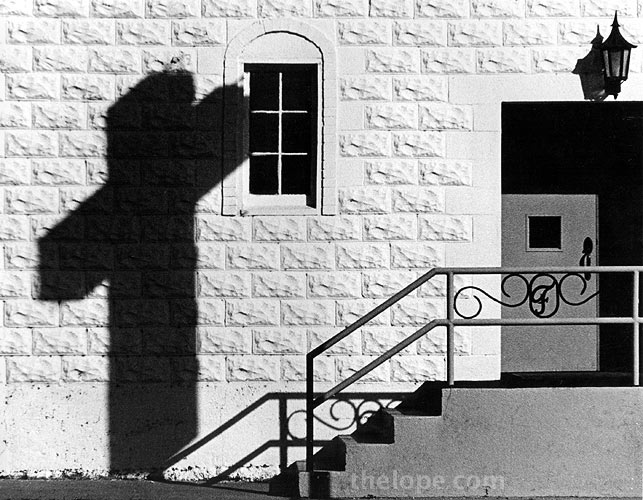
I often don't know why I'm here and I feel stupid suggesting that maybe the stage should be bare, with just a small, wooden cross (or maybe just the shadow of a cross) instead of a production worthy of the Super Bowl Halftime Show or the Academy Awards. In the end, it won't matter how tall the flames were or if you could feel the bass in the back seats. In the end, there is a message that challenges us to go out and live as Christ lived and died.

Maybe we need to reassess why we're doing this. Maybe we need to take a few steps back and ask if the fireworks and choreography are all absolutely necessary to the impact of this gathering. I'm not qualified to answer that and I am open to the idea that I could be completely wrong about all of this, but the idea of simplicity and the power of a moment of silence is something I cannot shake.

All I can do is put it in God's hands and trust that he knows where he wants us to go. The rest is faith — simple as that.

Wednesday, August 10, 2011

Defining a New Christianity


Tonight, I went dancing with a few friends at a local bar. While the jazz band was taking a break, we sat at our table and sipped water. One of my friends, an atheist, asked me what I was doing this weekend, to which I replied that I was going to Wisconsin. I didn't immediately say why, so she probed. Finally, I admitted quietly that I was going to help plan a youth gathering. I said it quickly, almost under my breath. I wasn't ashamed of my involvement...or was I?

When you ask me what I am, I will often reply that I'm a writer or a filmmaker or a student or Albino Black Irish. I make it a point not to introduce myself as a Christian, though. In fact, most of my friends go years before they find out I go to church. But why all the subterfuge?

The moniker "Christian" once meant rebel. It identified you as a a committed follower of the teachings of Jesus Christ. Today, "Christian" means collaborator, bigot, or ignorant. So, what changed? Did Jesus' message change? Or did we change?

The church is broken. Centuries of brutality and bureaucracy has transformed a few pockets of zealous free-thinkers into a monstrous organization that, in many ways, ignores its founding principles. The public by and large sees Christians as backward, intolerant hypocrites and the reputation is well-earned. When I tell someone I am a Christian, I risk losing my credibility and their respect. That is a tragedy.

Today, there is no blood, but people in pews have fallen into a safe routine where they are called upon to do nothing more than sit, stand, sing, and put money in the offering plate. There has got to be more to it than that.

I shouldn't have to be ashamed because I believe. I dream of a new Christianity that gets back to the root of what it all means. Loving our neighbor (all of our neighbors). Caring for the sick and the needy.

There are needy people among us. Not just on the streets, but in the sanctuaries. There are people in need of a new, more spiritually-fulfilling Christianity — a Christianity that is not afraid to get its hands dirty to do what is right; a Christianity that doesn't fear questions or dissenting viewpoints. The church of the future should show the world that it practices what it preaches.

I am not a Christian. I am a Christian-in-progress — a flawed human being who wants to follow Jesus' example, who wants to be a good man, but struggles to get there. The church, while broken in many ways, is also a work-in-progress, but there is hope. We may have strayed, but our shepherd will guide us to greener pastures. We are saved by grace, even from ourselves.

Tuesday, July 26, 2011

Not the Kingdom You Were Expecting


Some days, there's a man with a sign standing on the southeast corner of the city hall lawn, where the road leading to my house dead-ends at Route 66. Sometimes, his sign alleges that abortion is murder  and sometimes it proclaims that Jesus is the only way to be saved from eternal damnation, but last week it was telling me to repent, because the Kingdom of God is near.

"The Kingdom of God is near," we are told. The words sound strange. From the perspective of a political science student living in a representative democracy in the early-21st century, a kingdom doesn't necessarily sound like a good thing. The word kingdom conjures up all kinds of images of brutal tyrants and plagues and little thatched huts. It doesn't sound like the kind of place where I'd want to live. Maybe "kingdom" doesn't mean what we think it does.

In Matthew 13:31-33, 44-52, we are confronted with a laundry list of parables explaining what this kingdom is all about. It's unlikely that Jesus really said all of these in one sitting, so we can think of this as a "Greatest Hits" list that the gospel writer put together. The parables may not have been meant to go together, but the picture they paint is of a kingdom that is very strange indeed — not at all like the kingdom we heard about in Sunday School.

In the first of these parables, Jesus says, "The kingdom of heaven is like a mustard seed that someone took and sowed in his field; it is the smallest of seeds, but when it has grown, it is the greatest of shrubs and becomes a tree, so that the birds of the air come and make nests in its branches."

A mustard seed? Really? Jesus' audience must have thought they heard him wrong. When you think of a plant that you would use to represent a mighty kingdom, you think of something large and majestic like an oak or a cedar, not the mustard plant. In Jesus' day, mustard was a weed, and a scrawny one at that. If left to its own devices, it would consume your field. So, the Kingdom of Heaven is a weed. Hmm.

In the second parable, the Kingdom of Heaven is compared to "yeast that a woman took and mixed in with three measures of flour until all of it was leavened." So, now the Kingdom of Heaven is a microorganism that looks dormant most of the time, but under the right conditions will disappear entirely, leaving only its effects visible. Curiouser and curiouser.

These are all strange ways of describing a kingdom, but Jesus isn't done yet. Skipping ahead a little in the text brings us to Matthew 13:44-52. Here, he fires off three parables in rapid succession. It's enough to leave you reeling. The Kingdom of Heaven is a treasure hidden in a field that someone finds, reburies, and sells everything they have to purchase the field. The Kingdom of Heaven is also like a merchant who sells everything he has to own just one pearl. The Kingdom of Heaven is also a net that catches fish of every kind, bringing them to shore to be sorted.

Never once does Jesus describe the kingdom of his father in the terms of an earthly kingdom. There is no ruler and no subjects in a traditional sense. No palaces, no walls, no armies standing guard. To think of the kingdom in those terms is to limit God, who far surpasses our puny abilities to understand the nature of the universe.

What then, is the Kingdom we hear so much about in church and on street corners? What is this paradoxical realm that Jesus is describing?

The Kingdom is a living thing — an organism that is invisible  but recognizable through what it creates. The Kingdom is hidden; buried, and must be uncovered; unleashed. The Kingdom draws everyone in, making no distinction between the differences we perceive. The Kingdom makes you desperate, drives you to leave everything you have so you can be a part of it. The Kingdom is insidious; a weed that takes over and spreads to consume everything. The Kingdom sounds impossible, but it is here and it is now. It is all around us and it is in us. The Kingdom is beyond our comprehension.

This is the Kingdom as it is, but not the kingdom we were expecting. It is dynamic and powerful. It is inescapable. The Kingdom of God isn't near: It's here. It's been here all along.

Thursday, July 7, 2011

Minneapolis: The Right Wrong Man for the Job


In high school, I was not part of my church's youth group. I didn't exactly believe in God in those days. I was never confirmed and I certainly didn't attend any big Lutheran youth events. I was skeptical of the born-again mentality and the "rah-rah Jesus" crowd and I still am. So, imagine my surprise when I received a phone call from a beloved former pastor asking me to be part of the creative team for the 2012 ELCA Youth Gathering in New Orleans. Now, imagine my surprise when I considered the offer and said, "yes."

Next summer, some 37,000 high school-aged Lutherans will descend on the city of New Orleans for a week of spiritual excitement. And I, of all people, am helping to shape their experience. It blows my mind that I am currently sitting in a hotel room just south of Minneapolis, considering how to welcome and engage that many young people. The people in charge must not have heard about me.

I shouldn't make assumptions about the people who attend these gatherings and what they experience. From what I heard, the experience is powerful, even transformative. That's a lot of pressure being on the planning side of things.

Yet, I find my biases disappearing. The other members of the team come from all walks of Lutheranism across the country and are committed to making this an event that fires people up without being corny; excites people without being elitist. I hope that my unique perspective — as an outsider, as a doubter, as a Christian who hasn't quite figured out the Jesus thing — will help make this event profound and grounded in the realities of faith instead of what one member of our team called "cotton candy faith" (ie. mostly air).

The theme of the Gathering is "Citizens with the Saints," taken from Paul's letter to the early church in Ephesus. In Ephesians 2:14-20, Paul (or a later writer heavily influenced by the Pauline tradition) writes:

"For he is our peace; in his flesh he has made both groups into one and has broken down the dividing wall, that is, the hostility between us. He has abolished the law with its commandments and ordinances, so that he might create in himself one new humanity in place of the two, thus making peace, and might reconcile both groups to God in one body through the cross, thus putting to death that hostility through it. So he came and proclaimed peace to you who were far off and peace to those who were near; for through him both of us have access in one Spirit to the Father. So then you are no longer strangers and aliens, but you are citizens with the saints and also members of the household of God, built upon the foundation of the apostles and prophets, with Christ Jesus himself as the cornerstone."

 In this piece of Scripture, I see so much potential. Here, we as a community admit that we are broken and split, but reconciled through Jesus' death. We have been outcasts and outsiders, but God has taken us in and given us citizenship. We have become members of the family.

In the next few days, the creative team will wrestle with how to bring this Scripture to life for tens of thousands of teenagers. The challenge excites me and I am eager to contribute in my own small way to the discussion. The future of the church rests with the youth and it is my honor to help guide that future through what these students see, hear, and feel at this gathering.

To look at my past, I would appear to be the wrong person for this job, but Christ has broken down the dividing wall and made me a citizen of a new nation. With God guiding me this weekend, I think I might just be the right wrong person for the job.

Saturday, July 2, 2011

How Do We Punish Evil?

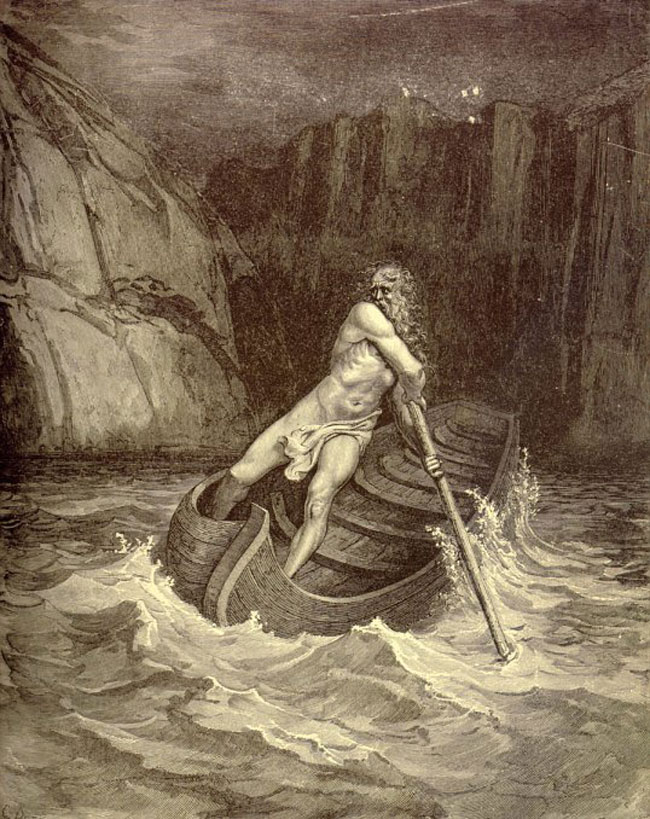
Medieval depiction of Charon ferrying souls to Hell, from Dante's Divine Comedy.


I watched the clock on Thursday morning, waiting for 11:11 am, when I knew a man was going to die. Richard Bible, 49, of Flagstaff, was executed by the State of Arizona by lethal injection and I was unsure about how I felt about it.

I spent the morning reading articles, trying to form an opinion. Bible had been on Death Row for more than 20 years, after being convicted of the molestation and murder of a 9-year-old girl in 1988. People were saying that justice was finally being served.

People like Bible make me sick. I can't imagine what could possess someone to commit such horrific crimes. I don't know if it there really is such a thing as evil, but if it exists, it must take the form of rapists and murderers. A little girl had been tortured and brutally killed. I can understand why people were calling for blood, for revenge, for justice.

And yet, at 11:11 am, I took a moment to say a short prayer. I wasn't asking for God to forgive this man or excuse his crimes. I prayed for his family and for the family of his victim, who had suffered for 23 years. And I asked God if this was right. Should we govern the world we are here to take care of on a system of "an eye for an eye?"

In Exodus 21:12, the law given to Moses explicitly states "Whoever strikes a person mortally shall be put to death." In Exodus 21:23-24, it is decreed that "If any harm follows, you shall give life for life, eye for eye, tooth for tooth, hand for hand, foot for foot." The law is clear and the punishment is severe, as it is today.

Yet, Jesus appears to contradict this, saying in his Sermon on the Mount, "You have heard that it was said, 'And eye for an eye and a tooth for a tooth.' But I say to you, Do not resist an evildoer. But if anyone strikes you on the right cheek, turn the other also" (Matthew 5:38-39). Does Jesus really want us to be passive and do nothing when we're harmed? Wouldn't that just lead to a world where those who follow Jesus' teachings are oppressed and those who practice evil are free to do as they please?

Like so much of what Jesus says, this just feels wrong. Our judicial system operates on the basis of punishment. If you kill someone, the system kills you. A life for a life. People like Bible shouldn't be allowed to go free. It makes sense to punish them, but it won't return Jennifer Wilson. It won't replace her and it won't free her family of the anguish I'm sure they still feel over her loss.

I feel a sense of relief when men like Bible are punished. It feels like balance has been restored and yet, I can't revel in the death of a human being. I feel spiritually dirty when I catch myself thirsting for vengeance — like I'm cheering at the Coliseum, hoping to see a man's blood spilled.

I'm beyond confused. On the one hand, I think Bible got exactly what he deserved. On the other, I know that Jesus' way is one of love and grace for people who don't deserve it. Was the state justified in sentencing Bible to death? Am I right to feel good about it? Is this a fair exchange for the life of a 9-year-old that was cut short?

What am I supposed to believe, as a Christian-in-progress? How am I supposed to feel?

Monday, May 23, 2011

Angry at God


Do you ever feel like the whole world is against you? Like your entire life is crashing down around you? Do you ever get so frustrated with your situation that you just want to lash out and scream curses at the heavens?

If you've hung around me for any length of time, you've probably heard me bring up Psalm 77 (one of my favorite verses). In it, the Psalmist wonders if God has abandoned him, saying:

"You keep my eyelids from closing;
   I am so troubled that I cannot speak.
I consider the days of old,
   and remember the years of long ago.
I commune with my heart in the night;
   I meditate and search my spirit:

‘Will the Lord spurn for ever,
   and never again be favourable?
Has his steadfast love ceased for ever?
   Are his promises at an end for all time?
Has God forgotten to be gracious?
   Has he in anger shut up his compassion?’"
- Psalm 77:4-9

When the world is dark and we cannot see the light, has God deserted us? Does he even care? We hear so much about a God who loves and provides, but there are times when I can't see it. How is God providing for us when we lose our jobs or our loved ones? How is God demonstrating love when we're pushed aside and told we're just not good enough? Were is God when bad things happen to good people?

Like the Psalmist, I question. I want desperately to believe that this is all part of some grand plan, but here in the depths of my life, I feel alone. I'm ashamed to say it, but it is usually when times are the hardest that I have the most trouble believing.

I get angry. I scream at God. I denounce God. I argue with God and try to get him to bend to my will. "If you really love me, you'll fix this mess!" I say. Even when I do things right, I don't always get what I feel I deserve in return. Like Jeremiah, I feel like I've been tricked. "You deceived me, Lord, and I was deceived; you overpowered me and prevailed. I am ridiculed all day long; everyone mocks me" (Jeremiah 20:7).

I get so angry with God and later, after I've gone for a long drive and calmed down a bit, I feel bad about it. But I don't have to apologize. I'm human and God understands that — after all, he made me this way. Yes, I have doubts. Yes, I sometimes get mad at God, but God can take it. And not only does God put up with my outbursts, he forgives me and never waivers in his love for me. I am blind, but God is determined to make me see.


God isn't a vending machine. We don't always get what we want and things don't always work out. And it's okay to be angry. I'm still bitter about the other times when I have felt abandoned by God. It doesn't feel fair and our lives often aren't. Bad things happen to us. We come up short. We lose. But, through it all, God is with us, even when we're sure he's not. It's okay to be angry with God, because no matter what we say or do, he doesn't give up on us. That's gotta be love.

"Your way was through the sea, your path, through the mighty waters; yet your footprints were unseen." - Psalm 77:19

Thursday, May 19, 2011

The End is Nigh (But Don't Quit Your Job Yet)


I'm not making any plans to be Raptured on Saturday morning. Even if the Rapture was coming, I'm pretty sure I wouldn't be going, anyway. But either way, I'm not expecting anything to be different when I wake up on May 21st.

There is a growing group of Christians who believe that the long-awaited end times are upon us. I simply don't buy it.

Human beings have a somewhat dark obsession with the end of the world. It fascinates us and for more than 2,000 years, people have been trying to predict when the Second Coming will occur — and every time, they have been wrong.

Over the centuries, various interpretations of Scripture have pointed to the Rapture and following tribulations as taking place in the year ~30 CE, ~60 CE, 365, 500, 900, 968, 992, 1000, 1033, 1147, 1284, 1496, 1533, 1669, 1689, 1736, 1832, 1843, 1844, 1881, 1914, 1915, 1918, 1920, 1925, 1941, 1975, 1994, and 2000. Every date has come and gone and we're all still here. The odds of being able to pinpoint the exact date are slim-to-nil, if you even believe that such an event is coming in the first place.

I'm not sure I understand this fixation with the End, but I, for one, believe that Revelation is not the most important book in the Bible. I don't believe God wants us worrying about Judgment Day, but about our everyday choices and interactions.


As a Christian-in-progress, I have to ask myself: Would I live my life any differently if I knew that all of history was about to come to a close this week? Perhaps an even better question is: Would I live any differently if I knew that Judgment Day was five billion years away?

We shouldn't have to be scared into behaving ourselves. Second Coming or not, we should endeavor to live every day as Jesus would have lived it were he among us today. We can't control the future and we shouldn't live in fear of what it might bring. All we have is right now and we should do everything in our power to live Christlike lives in the here and now.

1 Thessalonians cautions us, saying, "you know very well that the day of the Lord will come like a thief in the night." So, why should we get worked up about these predictions? God doesn't abide by our timelines. We would do well to be humble and remember that we are called to serve and love one another, not to sit around and waste our lives waiting for a day that probably isn't coming any time soon.

To me, that thought fills me with hope, because I still have a lot of work to do before I'm ready for that day.

Wednesday, May 4, 2011

Flooding Back


[The following is a stream of consciousness post on a deeply personal matter. I'll be back to my normal posts soon.]

I hadn't thought about my childhood in a long time before my sister posted a link on her Facebook page to the '90s ballad, "Truly Madly Deeply." It's a love song that has probably been played ad nauseum at many a high school prom, but to me, this song has a deeper meaning. "Truly Madly Deeply" came out around the same time that my parents separated. We always had the radio on at home and so, for me, this song became the soundtrack to the first rough time in my life.

At seven years old, my whole world changed. I packed up half of my belongings and moved with my mom and 2-year-old sister from our big, beautiful house in an upscale neighborhood to a small, roach-infested apartment in one of the poorer sections of North Las Vegas.

It was scary. I was old enough to understand what was going on, but not quite old enough to understand why. It was the why that terrified me for the longest time. Having your parents divorce when you're young has a way of forcing you to grow up a little faster, even when your mom takes superhuman steps to protect and shield you from it.

I had nearly forgotten the song, but when I clicked on the video and the first notes came trickling through my headphones, I started to cry. All the times we scraped by to the pay the rent, when my mom had to sell rollerblades in dirt lots out of the back of a moving van, and when we would go dumpster diving for furniture and appliances or to Dollar Day at Savers to buy all of our clothes — it all came flooding back to me on a wave of tears that had been repressed for a long time.


Maybe it's just a coincidence that my sister posted this so near to Mother's Day. Listening to this song reminds me of my mom's strength and all of the sacrifices she made for myself and my sister. She was so committed to doing what was best for us. She worked at conventions, handing out flyers, even though she had a college degree in Business Management, so that she could keep my sister out of daycare. If she suffered, she did so quietly and with such dignity that we would've never known.

I don't know for the life of me how she did it. How did we survive on a paltry $300 a month in child support from my father — who never gave any indication that he was concerned for our financial situation? How did my mother hold everything together in the face of such seemingly insurmountable odds? I'll probably never know the depths of her strength and wisdom.

Because of my mom's sacrifices over many years, I have had the opportunity to become the man I am today. I have been able to realize my potential by following her example of hard work and stubborn determination. Her love inspires me. Because of her, so many of those tough times are augmented with beautiful, happy memories.

I'm still a little hurt. I'm still a little angry at my father for putting my family through such hell and haven't spoken to him in almost 5 years. But when I look back, there isn't much I would change. My mother has been happily married to a wonderful, caring man for almost a decade now. I have two more little sisters, whom I love and couldn't imagine living without. I have learned lessons that a life of privilege and money could never have taught me. The person I am today has been shaped and molded by this experience and it is ultimately good.

I feel like I'm getting to place where I will soon be able to heal the scars and I will once and for all put the pain behind me and remember only the good times. I take comfort in loving family, in supportive friends, in a God who doesn't abandon us, and in the words of a love song which was an unlikely source of inspiration in times of darkness:

I will be strong,
I will be faithful,
'Cause I'm counting on 
a new beginning;
a reason for living;
a deeper meaning, yeah.
...
And when the stars are shining brightly in the velvet sky,
I'll make a wish,
send it to Heaven,
then make you want to cry. 
The tears of joy for all the pleasure and the certainty
that we're surrounded by the comfort and protection
of the highest powers,
in lonely hours;
the tears devour you...

Sunday, April 24, 2011

Easter Sunday: Our Resurrection

Your friend's body is missing. His burial clothes are neatly folded in the empty tomb, but there is no corpse. You run to tell your friends, who are in hiding, petrified with fear that they will be the next ones to hang from a cross. Everyone runs back to the tomb, where two luminous beings in white are sitting where the body had been laid. "Why are you weeping?" they ask.

According to the Gospel of John, the disciples did not yet understand the Scriptures saying that Jesus must rise from the dead on Sunday morning. They thought someone had stolen the body and I imagine they were crushed. One last defeat in a terrible week that had turned everything on its head.

Imagine then, your surprise when one of the men in white softly calls your name. It's Jesus. Alive and well after you saw him suffer and die. He's alive!

Everything changes this day. Easter is not merely a celebration of a miracle from 2,000 years ago. The Resurrection has implications across the universe in all times and all places. For through Jesus' death and return from the grave, we are forgiven from all of the sins which had previously condemned us. All of our debts are settled forever. Jesus died for you, so that everyday, we might be resurrected.

We die and if it wasn't for this sacrifice of love, we would never come back. By all reasonable arguments, we don't deserve it. But God isn't bound by rules. God breaks the rules. Death is no longer a one-way street. We can return, even when we are dead to the world. Through Jesus' crucifixion, he has bought us new life.

The fate of everyone changes today, because of a sacrifice that we can't even begin to wrap our heads around. He died so that we could live. And that changes everything.