
Saturday, March 19, 2011

San Francisco: The Least of These

"Come, you who are blessed by my Father; take your inheritance, the kingdom prepared for you since the creation of the world. For I was hungry and you gave me something to eat, I was thirsty and you gave me something to drink, I was a stranger and you invited me in,  I needed clothes and you clothed me, I was sick and you looked after me, I was in prison and you came to visit me." 
- Matthew 25:34-36


This past week, I was privileged to spend time in San Francisco with Lutheran Campus Ministry at Northern Arizona University. We went to see how the church was adapting to and embracing the LGBTQ community as well as to witness to the desperation of the homeless community. To say the experience was powerful is an understatement.

I went in expecting to be a spectator, tapping on the glass of an urban zoo, but much to my surprise, I was fully immersed in the city and its complexity. I heard the stories of the homeless of San Francisco. I saw them as human beings and in them, I saw the presence of God.

My week in San Francisco will require months — if not years — to process and decipher. The interactions I had with members of the larger community and the bonds I formed with the smaller LCM community over late night discussions and shared experiences has shaken my faith and strengthened my desire to learn more.

The city itself is a contradiction. Poverty and decadence go hand-in-hand with one another. I remember one night, I sat and spoke with a homeless man (who in all honesty was a human Bible, constantly quoting scripture). His hands and face were filthy and right across the street was a Macy's and a Tiffany's. Everything he could not have was right there — where the homeless and the wealthy share the same streets. Despite all this, he said with a grin, "I'm not homeless. I'm just not home yet." I was struck by the stark socioeconomic stratification that we in America see everyday. Why are we not outraged? Perhaps more importantly: Why aren't we motivated to do something about it?
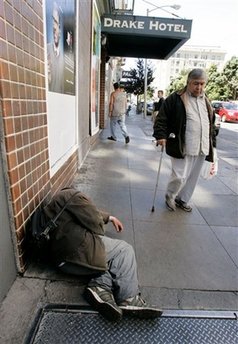
Whatever you did for one of the least of these brothers and sisters of mine, you did for me.

We have heard this story from Matthew many times and we tend to focus on the first section, where Jesus praises those who help the needy. Yet, I find that I usually fall into the second group — the people who ignore the "untouchables" of our society. We brush past the beggar with his plastic cup and we avoid eye contact with the lonely woman at the bus stop who just needs someone to talk to her. In our minds, we find ways to justify it. "Why doesn't she get a job?" "He just wants money to get drunk or high." Maybe that is the case, but it doesn't mean we shouldn't treat them with dignity. Maybe all they really need is a smile or a kind word. Maybe they just need someone to validate their humanity.

To all of us who would rather pretend like they're not really there, Jesus has his message:  

"'Depart from me, you who are cursed, into the eternal fire prepared for the devil and his angels. For I was hungry and you gave me nothing to eat, I was thirsty and you gave me nothing to drink, I was a stranger and you did not invite me in, I needed clothes and you did not clothe me, I was sick and in prison and you did not look after me.'
   
"They also will answer, 'Lord, when did we see you hungry or thirsty or a stranger or needing clothes or sick or in prison, and did not help you?'
   
"He will reply, 'Truly I tell you, whatever you did not do for one of the least of these, you did not do for me.'"
- Matthew 25:41-45

 My experience was uncomfortable at times, but it's when we are at our most uncomfortable that we often encounter the divine. Jesus is here among us, but he is not sitting in the pews of our churches and he is not attending dinner parties in the rich neighborhoods of San Francisco. He is sleeping in a doorway tonight without a blanket, without the medicine he needs and without so much as a friendly smile from a stranger. 

What do we do with that? I don't know, but together, maybe we can figure it out.

Monday, February 14, 2011

My Confession

Let me be the first to say that I was wrong.

Let me admit that my ways have not glorified God's name. I have harbored resentment in my heart. I have spoken ill of my friends and my enemies. I have followed the crowd when I should have stood firm. I have sinned. I have sinned so many times and so often that I hardly notice anymore; it is so ingrained in me that it has become habit.

I am broken. I am broken beyond words. I am a festering sore in the world, not a shining beacon of love. That is my problem. I have not loved. I have denounced my friends in the heat of the moment. I have not loved the way I am called to love. I am so wrong about so many things that I cannot begin to explain it.

I am arrogant, prideful, and convinced that only my way is correct. I need new eyes to see how very wrong I am. I need to make a 180 degree turn, because I am on a collision course with ruin.

To err is human. I accept that. I am humbled by that and by the fact that God always grants me a free gift of grace and a fresh start, no matter how many times I abuse it. I need to be humbled more often. I have lived a life of sin. I have polluted myself with my fickle emotions and quick, slashing rebukes.

I must live as your son lived and died, Oh God. I must be humble enough to carry the cross. I am not good at this, but I pray for the strength to try.

Let me be the first to say I'm sorry I let things go this far. Let me say that I'm sorry I didn't see the irony — that I did not see the answer to my questions in the very Bible I was trying to interpret. I cannot be as loving as Jesus, but I must strive to be more Christlike in all my interactions.

Create in me a new heart, Oh God. One that isn't swayed by ego or dubious morality. Let me be more like Jesus in all I say and do. Let me love your sons and daughters a ten thousandth as much as you do. I don't know why it took so long for me to get over myself and realize who you're calling me to be. I am broken and it is only through the mercy of God and following in the footsteps of Jesus that I can be made whole.

"I confess to almighty God,
and to you, my brothers and sisters,
that I have sinned through my own fault,
in my thoughts and in my words,
in what I have done,
and in what I have failed to do;
and I ask you, my brothers and sisters,
to pray for me to the Lord, our God."

- Common Prayer: A Liturgy for Ordinary Radicals

Let me be the first to say that I was wrong. I need the help of my Father in Heaven and of my brothers and sisters on Earth to get through this dark time. Please, pray for me.

Saturday, January 22, 2011

The 21st Century Church, Part Three: Leadership

I am always comforted when I read about the disciples. They consistently misunderstand Jesus, who he is, and why he came, just as I often do.

Over and over again the disciples persist in their belief that Jesus came to be a conquering king who would throw out the Roman oppressors by force. For them, Jesus was not just a leader, but a ruler who would do everything for them and deliver Israel from her occupation.

In many ways, we have a similarly lopsided view of leadership. We look for decisive leaders who will lead the charge and tell us exactly what to do. This is especially apparent in our church experience today. In most churches, we look to the pastor, priest, or minister to lead us, almost to the point of having them serve as faith surrogates — having them believe for us, telling us what to think, and taking care of the difficult questions so we don't have to.

That's not to say we don't need leadership. We do, but we don't need clergy to do all of the heavy work for us. We need people who can guide discussions and we need mentors, but we don't need the kind of leader who becomes the focus of church instead of the message. Jesus did not come to be that kind of leader. Jesus came to exemplify servant leadership — a person who leads by walking the walk.

Peter Rollins believes that the church of the future requires a different type of leader: One who refuses to lead. What we need are facilitators, people with expertise in theology and worship who can nudge us in the right direction; conversation moderators instead of de facto heads of the church.

It isn't the fault of our current leadership that church has become a spectator sport. We don't want to take responsibility. We don't want to assume the risk that comes with servant leadership.

But if we are going to be serious about following the path of Jesus we need to get down in the trenches. Only by getting our hands dirty in the work of faith can we ever claim ownership of our identity as followers of Jesus — as Christians we need leaders who push us to think, to question, and to discover on our own. We cannot live vicariously through our leaders.

If we don't take on that mantle of leadership, we as a whole can never hope to truly know what it means to be a disciple. We have been given a task to be the light of the world and bring justice to the nations and it is only by carrying out that mission that we make our faith real and keep Christianity relevant to the world.

Monday, January 3, 2011

The 21st Century Church, Part Two: Passion & Compassion

I heard somewhere that people have been using the word "church" incorrectly for centuries. "Church" has come to used as a noun — a word for the building, and occasionally applied to the people who gather inside its protective walls. However, "church" takes on a different meaning when you use it as a verb instead. The verb "chuch" becomes a action or a behavior — an experience instead of the physical bricks and mortar.

That's the kind of church that I long for. Nowhere in the Bible can I find the place where Jesus commanded his disciples to go build a bunch of cathedrals. So often, we "go to church," meaning that we go to a building that houses our entire religious experience. What a mundane way to experience faith. If we limit it to just the confines of four walls for one hour, one day a week, then we have completely missed the point.

This is yet another reason why I think the (noun) Church is struggling. There's very little satisfaction in such a shallow experience. In Acts 2:42-47, we get a very different sense of the experience of being church: "They devoted themselves to the apostles’ teaching and fellowship, to the breaking of bread and the prayers. Awe came upon everyone, because many wonders and signs were being done by the apostles. All who believed were together and had all things in common; they would sell their possessions and goods and distribute the proceeds to all, as any had need. Day by day, as they spent much time together in the temple, they broke bread at home and ate their food with glad and generous hearts, praising God and having the goodwill of all the people. And day by day the Lord added to their number those who were being saved."

That is what our experience could be — a dynamic church of devotion to teaching, fellowship, and community. An experience that combines passion for scripture and contemplation with a deep passion for outreach and goodwill. We, too, could praise God with glad and generous hearts, but to do so, we need to open the doors of our exclusive cliques. We have to leave the building and show compassion for our neighbors with the passion and zeal of the disciples gathered at Pentecost.

Some denominations are better at this than others (though now is not the time or place to be drawing those distinctions) and that is why I believe it is vitally necessary that a new, emerging branch of Christianity embrace the qualities of many diverse groups.

A 21st century Christianity should combine passion for God with compassion for those in need. Only then will it be relevant in our postmodern world.

Sunday, January 2, 2011

The 21st Century Church, Part One: Egalitarianism

It has been over 2,000 years since Jesus — the Word made flesh — came to live and die among us. 2,000 years since the teachings of a radical young Jewish rabbi inspired the founding of a major world religion. There have been many changes in Christendom since those early days and sometimes it can be hard to tell what parts of our church experience have been there from the beginning and which have accumulated over time.

The question I have is: Do we need all this extra stuff? How important is the ceremony and frills to our relationship with God? I know I'm not the only one asking these questions. I think most people are asking them deep down. What we need is not just an answer, but a new direction. The church is going to change in the 21st century. And I'm going to humbly attempt to articulate how in my next few blog posts.

The first big shift I see is away from the hierarchical church system we see today. I was privileged to have a foretaste of that church last night, when I sat down with my good friend Ron and dissected this week's scripture readings. What emerged from the evening was a deeper understanding of the text than could ever be gained from a sermon (no offense to any members of the clergy who might read this).

I suspect that this is much like the early Christian church in the first decades after Jesus' death and resurrection — a group of equals sitting down at a table, breaking bread together and discussing the tricky questions of theology and practice.

This our heritage, and I suspect it is also our future. There was no distinction between those behind the altar and those in the pews. There was discussion in an egalitarian community. Church, therefore, is not an individual experience, but a communal one.

A non-hierarchical church centered around the Word and the Eucharist, where we are all equal members of the priesthood and engaged in deep, ongoing conversation and discovery. That's the church I want to be a part of.

Monday, December 6, 2010

Grace to a Sinner


On that dark day at Calvary, Jesus was crucified alongside two criminals. In Luke 23:39-43, one of the criminals is indignant. He yells at Jesus, saying, "Are you not the Messiah? Save yourself and us!"

The second criminal rebukes him, saying, "Do you not fear God, since you are under the same sentence of condemnation? And we indeed have been condemned justly, for we are getting what we deserve for our deeds, but this man has done nothing wrong."

There are times when I wonder who I am in this account. Am I the bitter criminal hurling insults at God? Or am I the man who knows that I am rightfully condemned and have no one to blame but myself?

I will admit there are times when I am bitter. I get angry at God. I feel abandoned when things don't go right; when it feels the entire universe is conspiring against me. And so I scream to the heavens and demand an answer and compensation. I feel that God owes me something and is denying me the good that I deserve. After all, how many tests am I supposed to silently suffer through before I can ask when it will all pay off?

It's about this time that I remember how much I am like the second man on the cross that day. When I look at my life, I am often ashamed of what I see. I have the capacity to be a very un-Christian person. I am judgmental, lazy, cruel, selfish, hateful, lustful, and gluttonous. I don't consider others before myself. I put earthly gains over spiritual pursuits. I'm not just a sinner, I'm a repeat offender — taking forgiveness and then slipping back into my old ways. There is evidence to put me away. I'm guilty and I know it.

The criminal understands that he belongs up on a cross, dying slowly and painfully for his crimes. He takes a chance in what he says next: "Jesus, remember me when you come into your kingdom."

Surprisingly, Jesus' words to this man are not words of judgment or condemnation. He doesn't call down fire and brimstone, but instead offers words of comfort and grace. "Truly I tell you, today you will be with me in Paradise."

We don't know what this man did to deserve his punishment. Jesus doesn't ask and it really doesn't matter whether he participated in a rebellion against the Empire or committed a murder — because he's us. Yet, Jesus is merciful to everyone, even those of us who count ourselves among the worst of sinners. That grace is something I don't fully understand. My sentence is just, yet Jesus says that I will be with him in Paradise.

I don't feel like I deserve it. I feel terrible, like I'm taking advantage of the system. But grace is a free gift, given to sinners like me. It's a promise that even when the world appears to be crashing down — when I'm condemned — God is with me, suffering with me. Even when I curse his name, he loves me. His grace truly is amazing.

Saturday, November 6, 2010

Love is the Solution

Communities are dynamic things. They grow and they shrink, they flourish and wither. Communities are alive and need to be cared for, or they will not survive. I like to think of the community I belong to as being like a garden. It can't be left to the elements; it must be watered and tended to. It requires love and any community that doesn't have love is dead.

In Mark 12:28-34, we are told that a teacher of the law came to Jesus and asked him what was the greatest commandment. Jesus replied: "'Love the Lord your God with all your heart and with all your soul and with all your mind and with all your strength.’ The second is this: ‘Love your neighbor as yourself.’ There is no commandment greater than these."

My dear friend and roommate, Amy, recently asked me, "How do you love God?" The question is trickier than it appears. How do we love God with all our heart, soul, mind, and strength? I'm not entirely sure, and I've been struggling with it for a while, but the closest answer I can come to is this: loving your neighbor is the first step toward loving God.

In Hebrews 13:2, we hear, "
Do not neglect to show hospitality to strangers, for by this some have entertained angels without knowing it." So, if loving God is loving others, then it's pretty important that we go out of our way to express that love, because we never know when there might be angels in our midst.

I am an active member of Lutheran Campus Ministry at Northern Arizona University and I love that community dearly. It has seen more than its share of change. Leadership has changed, new people have entered the group and old friends have moved on to other things. Change is the reality of campus ministry, and in many ways the world as a whole. We must not be afraid of change, even when it is scary.

It always makes me sad when someone in a group feels left out or unhappy. As a people person, my instinct is to please everyone. However, it is not my place to tell anyone what they can or cannot feel and passing judgment is God's job, not mine. All I can do is be with people in love.

There are those who aren't happy with our community. They have chosen to leave. I will miss them. And while I may not agree with their decision (because I feel that problems with the community are solved by dedicating more time to tending to our growth, not by leaving), I will continue to love them.

My spiritual experience at LCM centers very much around the annual Dinner Musical production and late-night theological discussions. Recently, though, I have had a lot of trouble enjoying these activities (especially the musical) because of the drama that has erupted within the group. I'm not blaming anyone. I don't care why it's happening, I just want a peaceful solution. What is the solution? What do we do when our community is shaken? The solution is love. I'm not here to play egos against each other. I'm not here to fight. I'm here to learn how to love, and every obstacle to that end is just another test of my commitment to the path I have chosen — the path that Jesus walked.

Love conquers all, and I hope the troubles our community is facing now will pass and we will all emerge from it stronger in our faith. When things are hard and we just want to lash out, point fingers, and make accusations, we're forgetting why we're here. We're here to love each other and if we can remember that, then we can solve all of our problems together.

Monday, May 10, 2010

Great Emergence

This past March, I had the opportunity to attend the Re-Emergence Conference in Belfast, Northern Ireland. About 60 people were squeezed into the little building in a residential area of the city to hear the keynote speakers and engage in meaningful discussion about the Great Emergence.

But what is the Emergence? Honestly, I don't know if there's a clear answer, but I'll try to give you the definition Phyllis Tickle gave in one of her presentations.

She defines the Emergence as a movement within the Christian church toward a non-hierarchical, de-institutionalized structure. It is, essentially, a new Reformation, and one that's definitely overdue.

Phyllis has a theory that every 500 years, the Church has a big rummage sale to get rid of all of it's old baggage and outdated ideas. Go back 500 years and you'll find the Reformation and the establishment of the Protestant tradition. 500 years before that, you'll find the Great Schism and the division between the Roman Catholic and Eastern Orthodox churches. 500 years before that and we see the Decline and Fall of the Roman Empire. 500 years before that brings us to the time of Christ. So, if we really are on a 500-year cycle, it's time for us to make some changes.

Our society is radically different than it was even 50 years ago. We live in a global world connected at the speed of light to every point on the planet and many people are leaving the church because it no longer serves their needs and addresses the issues that effect them. What do we need to change and how? There are lots of ideas, but very few answers at this point.

I am not qualified and I don't know if I'm called, but I am excited to be alive now as we try to hash out what the Emergence is and determine its direction. Where do we go from here? We question, we probe, and we try to interpret God's will for us. It should be an amazing journey.

Thursday, December 31, 2009

Endings and Beginnings

Today is the last day of many things. The year 2009 is drawing to a close. Winter break is also sadly slipping away. But to me, the most significant milestone is the passing of a decade. The '00s will be over in less than 12 hours and I wonder what that means.

I like to find meanings and connections in things, to try to sort out the chaos of life, and find some direction in my existence. The end of each year is when I usually sit down to collect my experiences, and this year is no different. In fact, the feeling that one chapter of my life is closing is more potent than ever.

Ten years ago, on December 31, 1999, I remember sitting in anticipation for a new millennium to begin. I was just ten days shy of turning 10 years old and rockin' the bowl cut (back before my hair was curly), with a full decade behind me. I was living in Las Vegas, in a two bedroom apartment with my mom and 4 year old sister. The countdown was starting and I was half expecting to see some kind of massive explosion on TV when the Y2K bug heralded the end of the computer age at midnight. Of course, nothing happened.

At the close of this decade, I don't anticipate much more than the usual fireworks and festivities. But an internal change has already begun. A seed has been planted in my soul this year that I feel will blossom in 2010. I am no longer the carefree grade school kid I was ten years ago. A long decade of hardship, heartbreak, and learning has brought me here - to Flagstaff, to college, to being just 10 days shy of being one-fifth of a century old, and to being a man with a lot of responsibility on his shoulders. This year, I have found independence, I have found my true friends, I have found a niche in this crazy world, I have explored my passions, I have reawakened my spirituality, I have discovered what love really is, and I have felt healing take the place of pain.

I am, in essence, reborn. Like this new year, this new decade, I have a chance to start fresh. I can take the lessons I have learned with me and leave the old sorrows and habits behind. I have always perceived my life as a journey and after many years standing still at the fork in the path, I have made my choice. I have committed myself to a direction that Robert Frost once described as the road less taken, and it truly has made all the difference.

Where the Teens will take me in 2010 and beyond I will learn with time. For now, I am content to look back on the last 10 years with nostalgia and look toward the next ten years with hope.

"For I know the plans I have for you," declares the Lord, "plans to prosper you and not to harm you, plans to give you hope and a future." Jeremiah 29:11

May your new year be happy and blessed, overflowing with the love of God. I'll see you next year.

Saturday, December 12, 2009

Living Intentionally

For me, church should be something you live in your daily life, not just on Sundays. Notice I say "should." That's how I feel, but I can never seem to make it happen. I just don't have the time to be church during the week, and that frustrates me.

The problem, I think, is that I surround myself with like-minded people (my friends from church) on Sundays, but during the week, it's just me. It makes sense - I am a highly social creature, and without others to keep me grounded, I will drift off. I am incredibly thankful for them on Sundays, but my soul craves more.

Among some of my friends, there has been talk of setting up an intentional community. The online dictionary defines an intentional community as "A small, localized, often rural community of persons or families pursuing common interests or concentrating on certain basic values." Now, I'm not so sure about the rural part, but the rest of the concept appeals to me. A close-knit community of people pursuing the same goal - being church in our daily lives.

I'm still doing my research and probing to find out what this community would look like, but I am intrigued. This could be the answer I have been looking for. I could really use a community that would support me and join me in my journey as a Christian-in-progress at this point in my life.

I think we all could use a community like that, but what does it really mean? How do we transform a good idea into a functional lifestyle? How do we live intentionally?

Tuesday, August 11, 2009

A Gift of Grace

(Breathtaking photo courtesy of Audrey Zannini. Please don't steal it.)

Let me begin by apologizing for the length of my absence from the blogging world. A lot has been going on in my life. In fact, it has been completely turned upside down. It seems as though everything has changed. It seems God felt my existence was overdue for some spring cleaning.

Over the past year or so, I have suffered off-and-on from depression. Nothing serious, nothing requiring any kind of medical attention, but the kind of depression that can set in and subtly start to overtake your life, the way vines will consume a building that isn't well cared for.

I was constantly reminded of how well I was doing - about my grades and my scholarship and the fact that I was buying myself a new car and that I had lots of friends...I was even making a claim to modest YouTube fame. But all of the accomplishments felt hollow. There was something missing. There was an emptiness - a hole that desperately needed to be filled.

As is my nature, I put on a happy face, a mask for my friends and family - one that disguised my pain from the world all too well. Only the Man Upstairs wasn't fooled for one minute. Even though it went unspoken in my prayers, God knew what was missing in my life, as he always does.

In all my experiences drifting in and out of faith, one of the few constants that I believed in were guardian angels. But not winged beings of light descending on clouds - just regular people sent to make a difference in other people's lives. And it was in my darkest moments of depression and self-pity that God sent a guardian angel to me.

Jesus summed up the Ten Commandments in just one over-arching maxim: "love each other." I had forgotten what that meant until a sweet young lady reminded me of the kindness and generosity that the human soul is capable of, but that is so often stifled by our self-serving society. The world could learn a thing or two from love. I know I have.

Thursday, July 9, 2009

Spirituality Test

My good friend Kinna found this quiz online. It looked fun, so I thought I would take it. Who knew it could be so insightful. Here are my results:

"You are a Mystic, known for your imaginative, intuitive spirituality. You value peace, harmony, and inner silence. Mystics are nurtured by walking alone in the woods or sitting quietly with a trusted friend. You may also enjoy poetry, meditation, wordless prayer, candles, art, books, and anything else that helps you connect with God.

Mystics experience God best through rich images and symbols. You are contemplative, introspective, intuitive, and focused on an inner world as real to you as the exterior one. Hearing from God is more important to you than speaking to God. Others may attribute human characteristics to God, but you see God as ineffable, unnamable, and more vast than any known category. You are intrigued by God's mystery.

Mystics want to inspire and persuade others, and need to live lives of significance. At times you push the envelope of spirituality, helping the rest of us imagine who we might become if we followed your lead.

Sometimes you may feel a bit guilty about your need for solitude and silence. If so, you probably have bought into the American myth that says being alone and doing nothing is lazy, antisocial, and unproductive. Stop it -- now. Give yourself permission to retreat and be alone. It's essential for your well-being.

On the other hand, don't get so carried away retreating that you become a recluse. That only deprives the world of your gifts and deprives you of the lessons that come from being with others. Some Mystics may have a true vocation for solitary prayer, but the rest of you need to alternate retreat time with involvement and interaction."

Most online quizzes are not this accurate, but this is me. It's no coincidence that I have lately been devouring the writings of Christian mystics like St. John of the Cross. To me, the universe is a mystery that we can never fully comprehend. God is so beyond our understanding that we have no choice but to trust in his presence and love. When I think about creation, I feel so small, but so interconnected with everything around me. It's intoxicating.

I like being a mystic. It makes life seem all the more beautiful.

If you want to take the quiz, you can find it at http://www.upperroom.org/methodx/thelife/. I'd love to hear what result you get and what you think it means. Peace!

Monday, June 22, 2009

No Strings Attached

As a human being, I am flawed and imperfect. I am learning to live with that. But even in my imperfection, I am surprised to see moments when I am more than just skin and bones. There are times when I have felt the Spirit working through me.

There is no possible way to describe that feeling. For me, it's kind of like an electric charge coursing through my body. It's exciting and full of joy. At the same time, it's peace, like lying out in the sun next to a mountain stream.

So much of the time, I push away that divine impulse. I reject God's love. All through high school, I was shut off emotionally. No one knew the pain and the heartache. Some people sensed that there was something wrong and tried to help, but I pushed them away every time. I now see that God was working through them to crack open the cold hard shell I had built over my heart.

My senior year, I came to a time of crisis. I could no longer carry my burden alone. By the grace of God, my friends were there, ready to share the load if I was willing to open myself up. It was scary, accepting that love. Perhaps it's human nature to assume that everyone, even God, has a motive, and that love must carry a price tag. But the Kingdom of Heaven, I have learned, is not at all like the world we live in.

My friends wanted nothing in return for my trust and the opportunity to be a shoulder to cry on. They just wanted what was best for me. So, too, God wants what is best for us.

When I opened up my heart, I was exposed to even greater heartache and emotional exploitation. I lost control, but in giving up that control, I opened myself up to an even greater gift of love. Love that was unconditional, that filled the empty places in my heart. I didn't have to pay for this love or earn it in anyway. A love with no strings attached and no fine print. This was a love that I had never before known and a love that I cannot live without.

And with God's love, I am complete. In the immortal words of the Beatles - all you need is love.

Saturday, June 13, 2009

What is the Trinity?

This past Sunday was Trinity Sunday, one of the most obscure festivals in Christianity. It is the day that we celebrate this strange idea that God is three entities in one and one entity split into three. Of all the concepts that are core to Christian faith, this one has caused me the most trouble.

It's hard to wrap your head around the idea that something can be both one person and three, or both human and divine. How is this possible? How can something or someone exist in this kind of dual existence being both and neither? That's not how our world works.

In the course of my roller coaster ride as a Christian in progress, I was lucky enough to stumble upon Father Richard Rohr, a Franciscan priest seen as one of the leaders of the emerging movement in Christianity. In the talk he gave at the conference I attended in March, he spoke at length about the mysticism that has been lost over the centuries. According to him, the early church didn't struggle with these questions. They were simply able to accept that not everything has a logical explanation. For me, that's still a difficult leap to make.

The leap that I need to make now is a leap of faith.

Faith. Another one of those tricky concepts. Total acceptance of God's will. Letting go of the rational and the material to make room for the wonders of God that simply have no explanation. Having faith in the trinity is difficult. I don't like to feel that I am not in control, but over these past few months, I have learned that I feel even better when God is in control and I'm just there for the ride.

In the end, it makes sense. God is everything. How could we possibly understand how he is moving through us and the people around us? We can't. But we can trust that he loves us and cares about what happens to us, even if his ways of caring for us are sometimes a mystery. In my experience, the things in this world that are the most mysterious are also the most beautiful.

Monday, May 18, 2009

Breathe In the Spirit

I probably should've posted this sooner, as it explains the title of this blog, but it is so hard to put into words. I'll give it a try.

At the Emerging Church Conference, one of the speakers was Father Richard Rohr, a Franciscan monk. One of the things he talked about was the Commandment forbidding the wrongful use of the Lord's name. Many ancient Jews took this to mean that you could never say God's name: "Yahweh" in Hebrew.

However, written Hebrew does not include vowels, only consonants, so it is the responsibility of the reader to add in the correct vowels. This meant that there were many different ways of pronouncing words. In the case of Yahweh, the correct pronunciation did not allow you to move your lips or teeth. It was physically impossible to say it, you had to breathe it. "Yah" when breathing in, and "weh" when breathing out.

Just try that. Breathe in and out, slowly saying God's Hebrew name. It's amazing to me how calming that simple act is.

In the same way, we do not need to speak when we pray. Breathing is prayer in itself. The Spirit is all around us, in the very air we breathe. So, I try to take some time every day to stop for a few minutes to breathe and be with God.

It's pretty powerful stuff, breathing prayer. And it may not make sense to a society that is conditioned to demand physical proof of everything. It's hard to see God is everything around us, but I believe he's there. It's hard for me to let go and simply trust in a power I cannot see or touch, but when I breathe it, I believe.

And when I can't think of the words to pray, I can take comfort in the fact that God doesn't need words to understand me. All I have to do is breathe.

Sunday, May 10, 2009

Lost

I am lost. I am alone. I'm not sure why I feel so disconnected, but I do. It has been nearly two months since my life-changing experiences in New Orleans and the Emerging Church Conference and I sense the spiritual adrenaline rush starting to wear off. I have come so long in such a short time in my journey as a Christian and yet, now, I don't know where to go.

There has been a lot of upheaval in my life these past few weeks. Final exams drained me, and now that summer has come, I am in the awkward place of not knowing what emotion to feel - with new friends leaving for the summer while old friends are returning. The people who lived out church with me over spring break are far away and I can't seem to make anyone else understand the transformation I went through.

With my fellow travelers gone until the end of August, I stand alone. No, not alone. God is with me. I want to continue the path I have begun. Up to now, I have done this as part of a group, but now, I have to do it myself. Just me, sitting down to discern my place in the world. Call it a spiritual coming-of-age. Let's see where it leads...

Thursday, April 30, 2009

Burned Out

For a college student, life is stressful. We're constantly being pulled in contradictory directions, keeping up with lecture notes and endless essays, all while trying to remember to eat daily, sleep ocassionally, and hold together some pathetic semblance of a social life. It's demanding, and after not too long, it gets harder and harder to keep up with everything.

All too often, my spiritual life gets thrown by the wayside, a casualty to my hectic schedule. I forsake religion to study or to cram in a little bit more time with friends before they all go home for the summer.

I used to think this was normal, but my relationship with God is far too important to discard, even for a short time. My life is crazy, but that is exactly why I need time to be with God. Without him, I starve.

Matthew 11:28-30 says, "Come to me, all you who are weary and burdened, and I will give you rest. Take my yoke upon you and learn from me, for I am gentle and humble in heart, and you will find rest for your souls. For my yoke is easy and my burden is light."

These are the words I need to hear right now. With my social and academic lives playing tug-of-war with my time, I feel helpless and alone. I can't do this all by myself. I need someone to help me carry my burden.

Finals are looming, but I can survive. All I need is a little quiet time to pray and the assurance that God is with me every step of the way. If I remember that he is there to comfort me when I'm frustrated and stressed and that he carries me when I think I cannot go on, then I have nothing to fear.

I'm exhausted physically, mentally, emotionally, and spiritually. I want to give up, but I am not alone. Even when the night is darkest, God is there to walk with me and lead me into the light. Now, that's a comforting thought to get me through my final exams...